Friday, 3 April 2009
Ghost Box

Thursday, 2 April 2009
Giant Sand
Two words and an Arizona burr; it's a recipe for intrigue. I ask Howe to elaborate. He kindly obliges.
"Well," he begins, drawing me closer to the phone, "it must have been embedded in my subconscious. However, I completely forgot about the advent of this scenario and happened to be sitting here completely still and almost ready for anything. I'd poured a stiff glass of my favourite scotch that I keep stashed at my favourite restaurant that I can't afford, and just like some old guy weathering on a splintered chair, waiting for my demise, the telephone rings… and it's my heart attack friend, that I've never met."
A little bit of background: this interview was due to occur exactly 24 hours earlier, but had to be postponed due to a little personal trauma, a health scare, that had taken place three days previously. Sitting at my desk following a cigarette that represented all the bad ideas I had ever had or ever would have, I noticed a tightening, dead centre in my chest. The tightening quickly solidified into a solid fist of pure discomfort. I tried flipping it off, but it wouldn't go away. At this point I started to sweat. My breath became laboured. I checked my face in the bathroom mirror and it was a sickly shade of grey.
I picked up the phone.
Roughly ten minutes later, I was in an ambulance. Thirty, and I was at the hospital with electrodes attached to my chest, and out of view (my choice) an orderly sucking out my blood through a needle in my arm. Ten hours or so, and I was on the street in Whitechapel with my intended, wearing a green hospital shirt, safe in the knowledge that I had not experienced a heart attack, but an artful imitator known as an oesophageal spasm. It could, the doctors told me, have been brought on by stress. I knew exactly which rat bastard – thanks Hunter – to blame for that, but that's another story for another day, comrades.
Oh, I say to Howe, you heard about that?
"Man, it's all over Denmark [Howe's current location and his wife's country of birth]. What happened exactly, you had an anxiety attack?"
No, I've had those before. This was different.
"Did you have the left arm go?"
No, just a chest pain. I started sweating, I turned grey…
"Your hair or your skin?"
Just my skin, my face. The hair would have been more distinguished. When your skin turns grey it's more like…
"…extinguished."
It might seem a tall order, but if the Angel Of Death is coming for me, I hope he's warm and funny and avuncular like Howe Gelb. It'd make things a whole lot easier.
For those who don't have access to the one-sheet, Arizona's most enigmatic sons, Giant Sand, have shimmered back into being and their new album is called Provisions. If 2004's Is All Over The Map was a dog-eared scrapbook of freakshow postcards, Provisions is more like a night drive on the way to a clandestine burial. Giant Sand always travel, smoothly or otherwise. This one's on the smooth side, but then 'smooth' is just a surface texture; there's no guarantee that what lies beneath won't draw blood. Ever since 1985's Valley Of Rain, Giant Sand have maintained a personable veneer while concealing a finely-tuned taste for chaos, using parched, countrified rock as a vessel for the exploration of inner and outer space rather than a refuge from the ravages of modernism. The only real constants have been Howe's voice and obvious enthusiasm for language, fusing to create a formidable cerebral superweapon, and his sensualist's attitude to musical texture.
"My work is totally scattered," confides Howe, who always sounds like he's confiding, no matter what he's actually saying. "At some point I bundle it all up and call it a specific thing, and the thing right now is this new Giant Sand record, I guess…"
How do you know when it's time for Giant Sand to re-emerge, as opposed to something that flies by any other name?
"It's in between something seasonal and something rotational, like a comet. It just kind of comes in and out of the atmosphere for a spell. It's like an atom, that little electron zipping around, and it's Giant Sand time in the nucleus when it gets close. Then this other electron zips around and it's 'Sno Angel [Howe's gospel-influenced 2006 project] time, then this other electron zips around and it's Gypsy Flamenco time.
Does Giant Sand dictate the style of song you write, or vice versa?
"No, it's not the songs. That's why we've changed songs every night… in the early days, for the first two thirds of this run, my run, I would change songs around every night, just because they were fucking asking for it. So I would mess with them, we'd make 4/4 songs into waltzes and see if that would fit, just to excite ourselves, we were playing to make this game out of it. By doing that, you bring this element of excitement into it, because you don't really know what's happening and everybody's in it to make it happen and see how far we can make it happen and to go to that place that makes it a little bit dizzy with it as opposed to making it tried and true and stale. It's not the songs, I don't think; I think it's more the flavour of the camaraderie. When you have a certain camaraderie it lends itself to a certain sound. That's what Giant Sand has always been."
Howe speaks of Giant Sand in a manner which reminds me of '60s and '70s counter-culture science fiction. It's entirely fitting, too; one can easily imagine the loose protagonists of Philip K Dick's A Scanner Darkly gulping back handfuls of Substance D to 2000's Chore Of Enchantment, or shoving a tape of 2001's Cover Magazine in the car stereo on the way to a pick up. This is something that separates Giant Sand from their lesser peers in Americana, perhaps attributable to Howe Gelb's considerable speed-of-mind; they disorientate. They knock time out of joint. They're everywhere and nowhere (baby).
"I think every artist – I use the term loosely… let's call 'em plumbers – every plumber has a sensitivity antenna that allows them to pick up signals at least 12 minutes into the future. So he just smells the smoke of the fire coming, and that's usually his smoulder, y'know, that's the sound he's making. So sometimes you come up with a record that'll need 20 years for people to find acceptable, sometimes it's only 20 minutes."
There's a sudden disturbance at Howe's end of the phone line; I hear an lightly accented voice. While the words are unclear, the meaning is unmistakable.
"Ah, they're closing! So I'll just sit out there with this? No, I'll sit on the wooden part… all right. The restaurant's closing up."
Oh, right, I say. I ask Howe what time it is in Aarhus. Ever polite, he conducts two conversations simultaneously, one with me, the other with the staff of the restaurant he's being asked to vacate.
"It's like 10:30 or 11:00… this is? You did? It's a nice bag. I love this little place. No, I'm good, it's good. Keep me young. You know, Friday night in Aarhus… yeah! I look a little weird here? Can you sit on these boxes? No, someone will take the chair, won't they, they'll throw it through the window. No, don't worry about it. Don't… I'll just sit right here and I'll be good [laughs] I don't need a chair!"
Thursday, 26 June 2008
Slayer
Monday, 23 June 2008
Devo
The Devolutionary Oath:
1. Be like your ancestors or be different. It doesn't matter.
2. Lay a million eggs or give birth to one.
3. Wear gaudy colors or avoid display. It's all the same.
4. The fittest shall survive yet the unfit may live.
5. We must repeat.
Devo started a joke which started the whole world crying. Okay, that isn't actually the case. What really happened was, Devo started a joke that eventually came true, a joke which reflected the outwardly vacant smile and repressed urges of the culture that produced them. Nowadays James Murphy may warble about 'North American Scum' to the delight of would-be ironists everywhere, but he's merely producing a comfortably numbed variant - minus the true horror - of the original manifesto originally developed by Ohio students Gerald Casale and Bob Lewis as far back as the late 1960s. Inspired partly by pseudo-scientific objections to Darwinism and, one suspects, partly by their own status in hometown Akron as sexually invisible egghead geeks, the manifesto of De-evolution is an ever-shifting collection of ideas, a satirical prism vital to the dissemination of Casale and Lewis’ cynical world view; Jungian psychology, Reichian Orgone theory, Crumb-esque sexual dementia, Church Of The SubGenius pranksterism all filter through, unified by the central idea that the human race has ceased to develop and is now sliding back towards its primitive origins. It isn't a world gone mad. It's a world gone stupid.
Devo started a joke which became serious at the precise moment Casale witnessed the murder of some of his fellow students by National Guardsmen at Kent State University on May 4, 1970, during a protest against the invasion of Cambodia launched by President Nixon on April 25. Four students were killed, nine were injured.
"It changed my life completely. That was the defining trauma. When you see people shot, when one bullet goes through a 19 year-old that you know, the hole, the exit wound that it leaves, all the screaming, the crying, the slow-motion like in 'Raging Bull'... within hours the university was closed. There were bands of deputised locals roving around in cars with shotguns. And the evening paper put out a false headline, 'Students have shot guardsmen'. So people were looking to kill students."
William Burroughs explained the concept of the 'Naked Lunch' as "the frozen moment when everyone sees what is on the end of every fork". The Kent State massacre would seem to have been Casale's own frozen moment.
"You watched a complete lie unfold. You watched the hatred. It was basically like a civil war. You've got to remember the people that shot the kids were the same age as the kids, they were national guardsmen, they were 19. And it was at the height of the protests over the Vietnam war, and the illegal extension of that war into Cambodia, without an act of congress, back when people were informed about their government and the constitution and they cared. Today obviously everybody just goes, 'Uh, give me my Frappucino and I'll put it in the cup holder of my SUV.' One lie after another, one cynical piece of misinformation after another, from this moronic junta that rules our world – nobody even turns their heads. It was a different world then. Ideas mattered, and the constitution seemed to matter to millions of Americans. It was real, it wasn't senseless killing, it was directed political hatred."
Casale and Lewis responded to this shocking absurdity with yet more absurdity. Fellow Kent State art student (and now highly successful soundtrack composer) Mark Mothersbaugh soon entered the fold, introducing the pair to the highly entertaining 1924 anti-evolutionary pamphlet ‘Jocko-Homo Heavenbound’ by one Doctor BH Shadduck. Devo was gradually reconfigured from a Dada-esque arts lab to a more focused audio-visual collective, adopting uniforms and embracing pop music as a possible means to an end.
“We were openly subversive in the beginning. But no-one was paying attention, that's the beauty of America – no-one pays attention at all. By the time it gained some kind of traction and got on the radar then certain people would write about it. As soon as we had any success we were viciously attacked as clowns and fascists and anti-humane. Completely misunderstood. People missed the irony and thought we were all for conformity.”
In 1974, Devo made ‘In The Beginning Was The End: The Complete Truth About De-Evolution’. Essentially an extended music video for two songs, ‘Secret Agent Man’ and ‘Jocko Homo’, the film introduced characters that embodied the concept of De-Evolution. Played by Mothersbaugh’s father Robert, General Boy symbolised 1950s-style paternal authority while his son Booji Boy, played by Mothersbaugh Jr in a plastic child mask, represented the tendency towards poop-playing regression Devo had observed in Western culture. An unmasked Mark in lab coat delivers a lecture to an audience of Jocko Homo (‘ape-men’) who later riot and stab Booji Boy to death. ‘In The Beginning...’ provided Devo with their first big messy splash, winning an award at the Ann Arbor Film Festival. This led to the vocal support of Iggy Pop and David Bowie, which in turn secured the band a deal with Warner Bros.
The film remains an uncomfortable experience. Not exactly funny and not quite serious, it aims for the guts of the audience and succeeds in inspiring a kind of creeping nausea. This queasiness is central to Devo’s aesthetic both musically and conceptually; satire exists to bring sickness to the surface, and songs like ‘Soo Bawlz’, ‘Be Stiff’, ‘Shrivel Up’, ‘Sloppy (I Saw My Baby Gettin’)’, ‘Penetration In The Centrefold’ and ‘Buttered Beauties’ act as conduits for the repressed urges of the American male. If Robert Crumb’s cartoons offered an exploded view of unfettered masculine sexuality reigning over its own uncensored kingdom, Devo’s frantic meditations on mongoloids, vaginal discharge, horny pre-teen mentally-handicapped girls and midgets who “play underneath... mama’s skirts all day” were their musical equivalent. And while their song structures tended towards an uptight jerkiness suggestive of a punishing, panicked bout of masturbation, the frequent squirts of analogue synth (especially dominant on the 4-track recordings collected on Rykodisc’s essential yet sadly deleted Hardcore Devo 74-77 compilations) are rudely redolent of bodily (mal)functions, the burp and squelch of messy sex, flatulence and diarrhea.
The synthetically-minded end of America’s noise underground owes a huge debt to Devo’s dirty-minded emissions. This band set the standard for angry male geek energy and prurient sexuality, and led some commentators to accuse the band of misogyny. It has to be said, they have a point - Devo songs often essay a gynecological curiosity that often spills over into cruelty, prodding and poking at the unfamiliar with a combination of lust and disgust. However Casale sees the band as victims, hapless undersexed outsiders without any hope of copping a feel, let alone subjugating the opposite sex. This seems disingenuous at first - as we all know, geeks can hate women too - but the perverse honesty of Devo’s sexual politics counts in their favour, and if it proves repellent, well... it is. What can you do?
“I don't think it was misogynistic at all. We were more like the Three Stooges, whenever they have girlfriends in one of their episodes they're being brow-beaten and pushed around and man-handled by the woman, you know, pussy whipped. We were passive males of tender tails in Ohio and we were on the short end of the stick when it came to women. What we noticed in culture though, was the complete hypocrisy where on the one hand sex is being sued to sell everything and on the other it's always being presented as bad.”
Something to be feared?
“Exactly. So when Mark wrote 'Penetration In The Centrefold' it was because some big magazine, like Penthouse or something had for the first time ever shown penetration in the centrefold. So he was like telling the news, he goes down to the store and… it was just reportage.”
“We used to put up these satirical and ironic statements that people took at face value, as serious manifestos. We said that ‘Rebellion and individuality is obsolete in corporate society’ and ‘Your mission is to fit in’. And they were like ‘Wow, these guys are fascists!’ You know, that's how Rolling Stone felt. Ridiculous. Clowns, Nazis, you know. While the real clowns and real Nazis were being put on the cover.”
Were the American rock critics a constant adversery?
“From the beginning, absolutely. They did not like what we were doing, it didn't fit in to the whole thing. All the radio programmers were like fake hippies who wore the satin jackets and were getting paid off in whores and cocaine and still liked The Eagles and just hated Devo.”
You mean you never got the opportunity to be paid off in whores or cocaine?
“No. We paid for our cocaine.”
At roughly the same time in England, Genesis P. Orridge and Cosey Fanni Tutti were launching their own offensive against the hypocrisy of decency, first as COUM Transmissions, then as Throbbing Gristle. It’s interesting to compare the two outfits. Like Devo, TG were lapsed hippies with an artsy background, they were inexorably drawn towards taboo subject matter, exhibited a love of synthetic texture and harboured a secret obsession with E-Z listening. They too, attracted accusations of fascism. It’s perhaps even more fascinating though to consider the ways in which the two groups diverged - brought up with pervasive American ideals of success, Devo briefly became the truly subversive pop group by way of their acute observation of such pop conventions as harmony, melody and damnably catchy toons. If this combination proved initially offputting to American ears, it quickly won the group a dedicated European following.
“Europe is where we first gained success. England got us in a big way right away, totally got the irony, the humour. Loved the performance quality of Devo and the multimedia quality. You know, the message was like ‘Ok we get it, great.’ and then they were on to the next thing. We actually probably lasted a little longer in terms of popularity in Germany, and believe it or not, Italy. Up to '84 we were very popular in Italy, so I think that in general the European audience was more informed, more sophisticated.”
But then, Europe was better prepared. There were obvious parallels between Devo and the streamlined epiphanies of Krautrock, especially Kraftwerk - the uniforms, the repetition, the steam-piston rhythms, the mannered, robotic method of playing - and no-one of great significance in America was using synths in such a goddamn European - or ‘faggy’, because in Europe we are all ‘fags’ - way. Devo’s 1978 debut album, Q: Are We Not Men? A: We Are Devo! was almost an honorary krautrock document, having been produced by Brian Eno at Conny Plank’s studio in Cologne. Although it’s now accepted as a post-punk cult classic, in truth it’s a little too clean, a little too Enossified, and as a result lacks the rough robotic energy and effluent electronic splurge of the band’s pre-Eno material. Casale and the band reputedly tried to convince Eno to perfectly replicate the sound of their demos, leading Eno to brand the band ‘anal’.
The Hornbyite drones of the mainstream music press will tell you that Q: Are We Not Men?... is the only truly essential Devo album, that Duty Now For The Future (1979), Freedom Of Choice (1980), New Traditionalists (1981), Oh, No! It’s Devo (1982) and Shout (1984) are little more the desperate splutterings of a novelty band outstaying their welcome, perhaps grudgefully admitting that motivational S&M anthem ‘Whip It’ from Freedom... is a pretty good tune. This news may shock some of our more sensitive readers, but guess what? They’re wrong. Over the course of these five albums, Devo dispensed with guitars in favour of gleaming, hi-definition (if frequently haywire) synthwork, while the lyrics swung wildly between pitch-black pessimism and pisstake perkiness. Post-debut Devo did not only give us ‘Whip It’, but also ‘Freedom Of Choice’, ‘Girl U Want’, ‘Gates Of Steel’, ‘Through Being Cool’, ‘Peek-A-Boo’ and ‘Beautiful World’. The latter, a bitterly poignant assault on the asinine positivity of the Reagan administration, is Devo at their angriest and most honest. It’s surprising and a little disappointing, then, that Casale considers the end of the true Devo to have taken place as early as 1978.
“I'm trying right now to make a feature film about us. It would start in 1974 and end in 1978 when we go on Saturday Night Live, and were a big hit that night. It's called ‘The Beginning Was The End’ and the way you watch the movie, you know that it’s over that night. That Devo, the real Devo, is over.”
So what was the Devo that came after that?
“Then you get to the corporate meat grinder, and all the things that come with it, both the good and bad. The pressures and the insanity, because basically your fate isn't your own any more. Because you can't really do that many things to control it.”
Of course, the news on every spud’s lips is that Devo are about to tour the UK for the first time in over fifteen years. Good news, right? A ‘legendary’ band returning to our shores, a chance to see something many of us were too young to experience the first time around. Yeah, great. Yawn. But wait - can this world really be as dumb as it seems? Could it be getting even dumber? And could it be that somehow Devo are more relevant now than ever? Maybe.
“Devo was a serious joke. We didn't even really believe things would get this bad. Now we see that we were unfortunately very right, beyond our expectations. De-evolution is real and we're all living in a de-evolved, corporate, futile world. Run by morons, and run by ideologues written by greed and religion of every stripe – it's not just the Muslims, it's our guys right here. They're itching for a fight because they're fundamentalist Christians. Your own guy Tony is in on that, and it's horror. A normal rational person that pays their bills, minds their own business has a high IQ just sits back in horror and watches the world be hijacked by morons and creeps. And pays the price. Nobody cares because there's a mass of sheep out there who are just consumer conformists, who have been turned into an audience. And they download ‘content’. And it's awful. And that's it. There's informed focus group who check an opinion poll and it's all moronic, a circus.”
Still, do we need another ‘legendary’ band clogging up the circuit? Not really. Fortunately Devo are hardly your average legends. Even when they’ve done the right thing, they’ve done it beautifully wrong, and as fellow Plan B writer Emily Bick remarked to me, they’re never going to be an easy hipster sell. Feel a bit queasy buying tickets for the nostalgia show? Good. It’s part of what it means to be Devo. And we’re all Devo.
“When I was in college, I would go and see John Lee Hooker or Howlin' Wolf and it was kind of like a war movie where I was scared but I loved every minute of it. It was intense and kind of threatening. But they were so good at what they did, and you couldn't believe they were doing it as grown men. I think when Devo walks on stage and can still do this stuff aggressively, it's kind of scary.”
Yes, Gerry. It sure is.
Asva
The music of Asva reminds me of the one and only time I took DMT. Up on a hill above Hastings, I saw constellations knit themselves into vast scorpion-like starships, a village in the distance take on the appearance of an illuminated medieval castle, control cables descend from the cosmos and the space directly above me solidify into a ceiling, through which a tunnel opened and I was drawn upwards into what I recognised as The Invisible College. Asva similarly cause one to ponder the the hidden geometries of magick and science. The title of their debut album, Futurists Against The Ocean smacks not so much of a genuine opposition as a juxtaposition or superimposition, the rubbing up or lamination of the immersive and mutable against the angular and monolithic. Of course, G. Stuart Dahlquist, Asva leader and avant-metal veteran (ex-Sunn 0))), Goatsnake and Burning Witch) offers his own interpretation...
“The visual and poetic art that resulted directly from the Futurist movement that occurred in Russia in the early part of the last century seems similar to Asva's contribution to our vast ocean of humanity, of listening choices,” he says. “Theres so much crap floating in that water! My hope would be that Asva and like-minded musicians, artists and writers could move to create a different level of listening... not trying to play the heaviest riff or rip anyones head off with some killer show, quite the opposite. Part of Futurist thinking (if I'm getting it right) is making something that hits you differently than smack in the face. Meaning is found through pondering, absorbing whats in front of you with mind, more so than eyes.”
Like his old bandmate Stephen O’Malley and the growing number of kindred spirits operating in the twilight zone between metal and drone, Dahlquist is acutely aware of his music’s capacity for physical and psychological transformation.
“Frequently, when done playing, my ears will pop, like coming up from a deep dive,” he explains. “The sound is what gets me off. Waves of bottom end just pushing right through me, Trey (Spruance, guitar) and Troy (Swanson, Hammond Organ)’s subtle juxtaposition, Jessika (Kenney, vocals)'s shrill screams, her beautiful lyric, B.R.A.D. and his skeletal drumming. I used to meditate a lot... I left my body, got scared, and now I've got Asva. So many times while playing shows, I've had to choke back sobs, the music just hits me so squarely in my emotional core.”
Asva: metal that moves.
Blue Oyster Cult
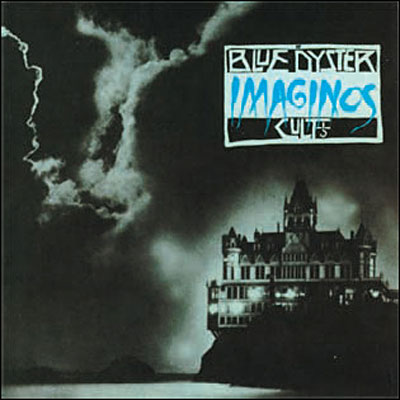
I remember embarking on camping holidays with my family in the late 80s and early 90s and a cassette of Imaginos (along with Secret Treaties, Spectres and a compilation entitled Career Of Evil) provided the perfect soundtrack to our inevitably rain-soaked trips to the south coast, or Wales. When you're young and susceptible to parent-induced boredom, music can add the necessary perfume to an imperfect situation, tranforming your predicament into something with the scent of adventure. The rain, sea and stars begin to whisper their secrets. The veil lifts a fraction. Magick is afoot.
"The Oyster boys are swimming now/Hear them chatter on the tide" - 'Blue Oyster Cult'
The concept of Imaginos was originally formulated in 1967 by Blue Oyster Cult manager, producer and lyricist Sandy Pearlman, and detailed in a collection of poems collectively titled 'The Soft Doctrines Of Immaginos'. Fragments of this concept surfaced in early 70s BOC songs such as 'Subhuman', 'Astronomy' and 'ETI' before its eventual shoring up into the album released in 1988. "Basically, it's an interpretation of history," explained Pearlman to Kerrang! magazine in September that year. "An explanation for the onset of World War I, or a revelation of the occult origins of it. Imaginos is the main character, and is what I call 'an actor in history'. He plays different roles in history and was born as a modified child, modified by an alien influence, and his mission is to present the human race with the challenge of evil. The aliens are playing with our history as if it's a game, and he motivates the game and presents the choices to the human race. They react as they will."
"The writing in the notebook/Notation from the stars" - 'I Am The One You Warned Me Of'
The narrative thread of Imaginos - described in the sleevenotes as a 'random access myth' - makes reference to the Spanish conquest of the New World, Haitian Voodoo, the reign of Elizabeth I and her counsel by occult advisor Dr. John Dee (who claimed to converse with spirits using a 'magic mirror' fashioned in Mexico from black volcanic stone), Lovecraftian gods, Egyptian fertility rites, hallucinogenic cacti ("Do the Don Pedro" - 'Les Invisibles'), the discredited Sirius myth of the African Dogon tribe as documented by Robert Anton Wilson in Cosmic Trigger, and the gothic literary traditions of Europe and America. Pearlman weaves a rich tapestry of truth, half-truth and out-and-out fantasy to spellbinding effect, and it is this rigorous dedication to the weird that makes Imaginos possibly the most literate and intelligent rock concept album ever devised. Enigmatic and often wilfully obtuse, Imaginos nevertheless lives up to its billing as "A bedtime story for the children of the damned." The cover image, perhaps harking back to the 'Black & White' trilogy of Blue Oyster Cult (1972), Tyranny And Mutation (1973) and Secret Treaties (1974), is a monochrome photograph of San Francisco's Cliff House Hotel, built in 1863. The hotel glowers on the cliffs, ghost-lit against a skyful of cumulonimbus. If I ever visit San Francisco, that's where I'd like to stay.
"Where witches went mad more than once" - 'Magna Of Illusion'
The unsavoury aspect of Imaginos becomes apparent when one considers its origins as a projected solo album by ex-drummer Albert Bouchard, and what appears to have been the wholesale hijacking of the project by Pearlman and the remaining members of BOC. Bouchard worked on the project with Pearlman after leaving the band in the early 80s, and BOC's label CBS showed interest, but allegedly requested that it be released as under the Blue Oyster Cult name. BOC broke up and the idea was eventually abandoned, but revived following the band's reformation - without Albert - in 1987. The released version of Imaginos contains basic tracks recorded by Bouchard and selected session musicians, with some elements overdubbed by Pearlman and Oyster boys Eric Bloom (vocals, guitars), Donald 'Buck Dharma' Roeser (vocals, guitars) and Allen Lanier (keyboards). Having been shut out of his own album project, Bouchard has expressed disappointment and anger at his old bandmates and manager. It's extremely unlikely that the original line-up will ever work together again.
"I've lived upon the edge of chance/For twenty years or more/And this is what my friends all mean" - 'Del Rio's Song'
Sonically, Imaginos is fucking odd, a disorientating blend of overblown pomp rock, AOR, metal and sea-shanty power pop. 'I Am The One You Warned Me Of', 'Les Invisibles', 'Del Rio's Song' and 'Magna Of Illusion' strike an uneasy balance between the sinister mysticism of Blue Oyster Cult, Tyranny & Mutation and Secret Treaties and the radio-friendly gloss of the group's post-'Don't Fear The Reaper' incarnation. This was clearly no formula for mainstream success, and the album effectively wiped itself from history. But it's the story within the story that makes Imaginos so fascinating. A narrative spanning 200 years of myth and magick, it stands as testament not only to one of America's greatest bands, but also the unsung imagination of Sandy Pearlman, a maverick conceptualist convinced that rock music could be a vehicle not only for atavistic gratification or the expression of utopian ideals... but also for the starry wisdom glimpsed in fever dreams and wild hallucinations.
"So ladies fish and gentlemen/Here's my idle plea/See me in the blue sky bag/Meet me by the sea" - 'Blue Oyster Cult'
Gescom
Minidisc was originally released in 1998 on the OR label and was the world's first Minidisc-only release. One of the selling points of this shiny new technology was that there was 'zero seek time' between track flips, something that now comes as standard on most digital media. It was Gescom's intention to exploit this feature, so they came up with 88 tracks designed to be played at random, theoretically offering the listener a brand new listening experience every time they pressed 'Play'. It reads like a smug contrivance, a clever-dick irrelevance. But when you listen to Minidisc in sequence it's impressive but ultimately really fucking dull, an interminable trudge through chops, bits and bytes seemingly designed to show off just how crazy a few geeks can get with a jolly bit of DSP. It's soulless, shallow, tiresome.
Use Minidisc in the manner its makers intended, though, and the project instantly comes alive in your ears. The juxtaposition between industrial drone and chopped-to-fuck hip-hop beats, twisted metallic klang and flatline hum creates something utterly compelling in its rapid-fire weirdness. Each of these 88 fragments work so well as random elements (rather than constituents of a fixed, finished whole) that the result forces a revision of how we listen to music, perhaps also foreseeing our culture's current predilection for Party Shuffling brief tinny bursts of digital sound. Of course, you could pull the same trick with any album. The crucial difference with this one is that you're meant to. And Minidisc is remarkable because it only becomes a coherent, cohesive piece of music when chance is allowed to configure its pleasures.
Hmm... did I say pleasures? Minidisc is much more noise than electronica, more Whitehouse than Boards Of Canada, and digital is perhaps the ideal format for noise lovers of a masochistic bent. Whereas analogue synthesis is generally mimetic of the sounds of the human body, the clean crackle of digital is alien and therefore instinctively threatening. When it doesn't sound sharp, brittle and invasive, it sounds crushed, fibrous and itchy. There are times when, listening to Minidisc, I recall the sting of fibre-glass on my hands from years ago, the tiny fragments stuck beneath my skin and the angry irritation that resulted. Digital isn't malicious or capricious, as analogue often is, it's merely uncaring and austere, a robot reconstruction of how things should be. This, of course, makes it fascinating, especially when users give up attempting to humanize its null flow and instead focus on the very lack of nourishment at its centre. Those seeking pain from their noise may have found a perfect, distant dominantion in its cold embrace. One of the things that characterises Gescom's - and Autechre's - music is an interest in sound as object in itself, rather than conveyor of meaning or emotion, which itself is suggestive of the dissociative nature of fetishism.
But there is poignance as well as blind sensation to Minidisc's constant flux, a layer of melancholy attributable to the fact that this album has been reissued on the very same format the Minidisc was designed to supplant. It's an acceptance of failure. Minidisc therefore enters a second lease of life as a requiem for futures past, a hymn to obsolescence.
Electrelane
- ‘Light’, Meat Puppets
I know a guy who loves Electrelane. That's understandable. I mean, what’s not to love? Thing is, the guy’s a misanthrope. He seems to have little faith in human nature, or the concept of love, or the redemptive quality of random acts of kindness. He is ‘into Crowleyian magick’ yet fails to divine the magical properties in a smile or a kiss, or even sex. All the world is merely grist to his dark Satanic mill. So here’s what I don’t understand: he dwells in darkness, whereas Electrelane largely trade in...
LIGHT! The same light eulogised by the Meat Puppets on their neglected 1989 classic, Monsters. The blinding flash, the eternal flame of illumination, the white-out, the O-mind. Sunshine through stormclouds, the silvery glint of a Greyhound bus, the shimmer of the sea in mid-July. Y’know, that kind of thing. How, then, can a misanthrope love Electrelane? Their music may have undercurrents of darkness, of mystery, but it’s so alive, so free and so fucking optimistic. It travels. It gets out a bit. It makes new friends. It feels a tug of remorse when it has, inevitably, to leave town. But it stays in touch.
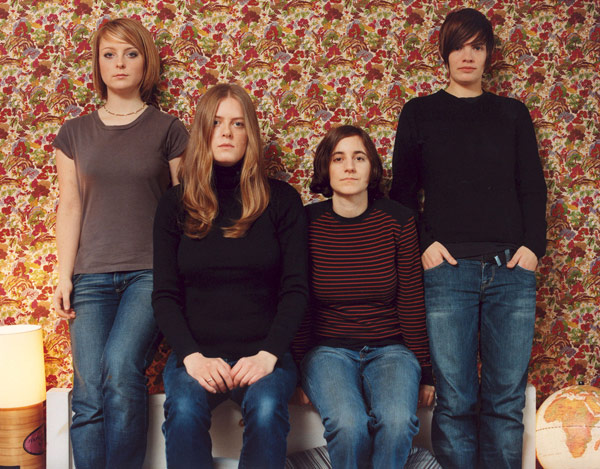
Electrelane’s new record, Axes, is for me characterised by the sheer joy it radiates. Not dumb joy, if there is such a thing, but joy at being alive and able to feel not only happiness but pain, loss, absence, fear and all the rest. And sadness doesn’t equate with darkness, by the way. It’s just a different kind of light, like the stroboscopic light that dapples your face on a long train journey in summer. I put it to Verity Susman, Mia Clarke, Emma Gaze and Ros Murray that the sheer amount of travel involved in being part of this band (originating in East Sussex, they now live, variously, in Berlin, Prague, London and Brighton) must contribute to the feeling of perpetual motion that characterises much of their music.
“I don’t think it’s a conscious idea,” replies Mia (guitar). “But I mean, we were travelling a hell of a lot last year. We were away a lot.”
Verity (vocals, guitar, keyboards) elaborates. “When you’re just sitting there staring out the window, with things going past... it probably stuck, it got lodged in our heads somewhere.”
There’s the sound of the train on ‘Gone Darker’, too, which you join in with as the song builds at the beginning. Do you enjoy all the travelling you do?
“I love it,” claims Emma (drums). “It’s my favourite thing.”
I mumble absently about the melancholy nature of travel, the feeling that you’re constantly leaving something or someone behind. This strikes a chord with Ros, the band’s new bassist .
“I was talking to someone the other day and they were saying that the saddest object is a suitcase,” she relates. “Which I thought was really funny, because I saw it a different way. Whenever I think of a suitcase I think of being really excited and happy. Then they said that, and...”
They ruined it for you.
(Laughs) “It depends on what colour it is.”
I wonder if I’m wrong to hear so much exuberance and delight in Axes. Perhaps I’m hearing what I want to hear, screening out the parts I’d rather not confront, like I know I often do in the ‘real’ world outside of music. Is mine a wilfully inaccurate impression, then? Could it be the side effects of the Cipralex? Or perhaps it’s the upside of all this motion: constantly in the process of getting somewhere and thrilled by the prospect of never actually arriving. I used to want to live on a train. I was only put off by the fact that even trains have to stop sometimes.
“It’s like you were saying about travelling, that it’s where sadness and happiness kind of cross, and yeah, I totally agree with that, ‘cause it can still be sad and celebratory at the same time,” says Verity. “I think we get a kick out of when it’s quite sad, and then making it really happy; like, how can you get out of that minor bit into the happy part again.”
Axes was recorded largely live, in one room, the band able to look each other in the eye as they played. If Electrelane weren’t so active in rewriting rock, this would come across as somewhat clichéd, the kind of thing tired old hippies, punks and vinyl obsessives love to harp on about. But Electrelane make it all seem so new and inviting, and no, not because they’re female but because they’re still growing as a band. They’re still seeking and striving on their third album, the point at which most bands find themselves apologising for their recent past and going back to basics in an altogether less becoming fashion.
“Because we were all recording in one room, it was impossible sometimes to replace one part, so most of the time we kept the basic tracks, the live take of everybody playing together even if there were mistakes here and there. In the past we’ve been more neurotic about ironing any little inaccuracies out. This time we didn’t really think about that and I think the freedom in the songs is much stronger than on the last album.”
This may have something to do with Verity coming into her own as a lead vocalist. On ‘Two For Joy’ she conveys pure emotion so forcefully and unaffectedly, you’re knocked back for a moment; you don’t quite know how to react. Her delivery is blissfully uninhibited, flawed and unaffected in its soulfulness. When the song reaches its peak and Susman’s excitable whoop (possibly the most rock ‘n’ roll thing you’ll hear this year) gives way to a final, valedictory burst of Farfisa organ, you’re finished. There’s a new confidence there, but also something greater, an open-heartedness that transcends the vagaries of that most elusive yet overrated of commodities, ‘cool’. Which means that while Axes will kick your arse no problem, it’ll kick you even harder in the heart.
“I think the vocals this time were easier to do because we toured so much last year, so I just got used to singing a lot,” Verity states. “And then when I went in to record I had a much clearer idea of how I wanted the singing to sound. I tried not to do too many takes and it was normally the first one that would be the one that I’d keep. With singing, more I think than with anything else, once you start repeating it over and over again it starts to become laboured.”
From listening to the records and talking to the band, it seems that Electrelane’s methodology revolves more and more around the removal of the unnecessary, anything that could be interpreted as contrived, or as Verity puts it, “laboured”. But in paring back the components of their sound to the bare essentials, they are able to maximise the emotional impact of what’s left in. In keeping with this, all additions are made judiciously, not frivolously (like the hint of klezmer that suffuses the giddily romantic ‘Eight Steps’) In Mia’s words, Axes is “clearer” than their previous records. The sound is still dense, but it breathes. This breathing space is clearly precious to Electrelane; Verity frequently uses the word ‘freedom’ when expressing her happiness with the new material. Given that improvisation forms the basis of Electrelane’s aesthetic – all the songs on ‘Axes’ started out as jams – I ask whether the band intend to pursue this freedom even more when they play live.
“I think we’re gonna improvise a lot more on stage than we have done in the past, just because we’ve done so many tours,” she states. “I think we’re probably more confident now, playing together and playing live, to be able to risk something completely messing up (laughs).”
But would you ever consider doing something completely free?
“I think that’s what we wanna get to. Yeah.”
“But not totally improvised. I would shit myself!” laughs Mia. “Like, we played in Austria with Tony and Andy from The Ex, and obviously we hadn’t rehearsed or anything, and they were like, ‘Oh yeah, we’d really love to come on and play’ and it was like ‘OK, cool!’ [nervous laughter] I mean, I enjoyed it, but only after the fact. While they were on there, ‘cause you’re so used to just hearing three other people...”
“They have very distinctive ways of playing,” says Emma.
“...so I’m trying to listen to the band, and then Tony and Andy were like, ‘Eek! Eek! Eek! Eek! Eek!’ with screwdrivers and everything...it was like, ’What’s going on?’ [laughs] It was fun, but it was very frightening.”
That Electrelane can admit to this fear makes them even more valuable. After all, fearless people are either mad (not their fault), stupid (not their fault either, but you can blame them for the success of Razorlight) or just plain fake (unforgivable in most cases). Fearless people are also rather dull, as they have little to lose and less to talk about. Electrelane are none of these things. Their music expresses humanity, frailty and the strength that comes from clinging onto light even in the darkest times. Perhaps that’s why the misanthrope loves them. And perhaps that capacity for love will ultimately redeem him. Here’s hoping.
Municipal Waste
Municipal Waste are perhaps the third or fourth best thing to death in terms of escaping the sickening realities of life and embracing chaos. For all its communal nature, partying is a form of denial, inevitably so, because what is there to party about really when one takes in the constant bomb threat modern life has become? Partying is about denying reality you’ve been handed and creating your own, a responsibility-free zone. Selfish? You bet. It isn’t party for your right to fight, as Public Enemy once detourned their labelmates, The Beastie Boys. It’s party for your right to party. Harder than ever. Til it hurts.
So as the world gets shittier, the grimily hedonistic hi-energy buzz of thrash metal is understandably enjoying a criticial and commercial resurgence. The surprise about this revival is that it seems to be throwing up a few bands who sound vital and venomous enough to survive the fickle attentions of the music media (ourselves included). Nottingham’s Earache have smartly bagged three prime movers; Huddersfield’s Evile, Merseyside’s awesome SSS and the big bros of them all, Municipal Waste. The latter’s three full-length albums to date, Waste ‘Em All (2003), Hazardous Mutation (2005) and the new The Art Of Partying may bring to mind the spotty, split-ended Metallica that recorded Kill ‘Em All, the DRI that unleashed Dealing With It and Crossover and especially the Exodus of Bonded By Blood, Pleasures Of The Flesh and Fabulous Disaster, but they hardly sound like a tired, money-minded re-run of something that worked better twenty years ago. And in person, they seem 100 per cent sincere - these dudes shit metal, which is probably uncomfortable, but they seem happy enough, considering.
"I think metal got pushed over the edge,” says vocalist Tony ‘Guardrail’ Foresta, a likeable fellow whose face habitually forms what can only be described as ‘a shit-eating grin’. “Like in the past five to ten years, it got shitty, and then it got shittier, now you got dudes dressed as girls wearing fuckin' make-up playing fuckin' screamy breakdowns, and all these people who grew up listening to Priest and fuckin' Slayer look at it and it's like, 'What is this bullshit?' Y'know?"
"I think a lot of those bands, they write the music and it's just kind of accepted that you write lyrics about violence and dark imagery,” states bassist/vocalist Philip ‘LandPHIL’ Hall. “They're just like, 'Ok, whatever...' and just pump out a bunch of lyrics. It's just kind of accepted if you have a death metal band then you write about gore, y'know? So they're just like, 'Alright, we'll write about gore...'"
"The funny thing is,” continues Ryan, “when we write about gore, people just laugh at it. Our shit's gory as hell! If you really read the lyrics it's like, 'Damn, that's kind of negative!' But everyone's laughing about it, because we're just having fun with it."
At this point in the interview, I think about what I’ve heard from other music journalists about Municipal Waste. Apparently, some interviewers have found the band hard work, too boorish for their delicate sensibilities, too keen to proselytise on the joys of cheap terror, good beer and nice tits. I can see why some might find all this a little lowbrow for their tastes. But would it be too blunt to suggest they pull the baguette out of their arse and loosen up a little? Let’s look again at that list: cheap terror, good beer, nice tits. Fuckin’ hell. What’s the problem here? Now, beer is righteous (hmm... kinda) but why talk about it when you can drink it? I decide to skip over that and aim straight for the terror and tits. Priorities, right?
So what films inspire the lurid goo-spattered vistas of Municipal Waste tunes?
Tony: "Repo Man."
Ryan: "We sample that on one of our old records. It's a classic."
Have you seen Tarantino and Rodriguez’s ‘Grindhouse’ double feature yet?
Ryan: "I like ‘Planet Terror’, the first half of it. That one smokes the other one.”
Tony: "I like them both. I think the second one, the Tarantino one could have been edited by about 20 minutes."
Ryan: "The dialogue was just annoying. It's a man writing women's dialogue and he didn't know what the fuck he was talking about."
LandPHIL: "Totally."
Ryan: "The first one was just so over the top. If we could make a Waste video that looked like 'Planet Terror'... I mean, the toxic element's there."
LandPHIL: "Lots of green, lots of gore, hot chicks!"
Ryan: "Choice use of cursing like in old '70s movies... 'Shee-it!' Hahaha!"
Dave Witte: “Those dudes are in love with the original ideas, the history. Which is kind of close to what we're doing. Everything has been manipulated and bastardised, but we go to the roots of it. A lot of people don't recognise the start - it gets lost. Then the bands get shitty, people get bombed out. It's all cycles."
Drummer Dave Witte (ex-Discordance Axis/Burnt By The Sun) is vaguely reminiscent of Jeff Bridges’ character The Dude from the Cohen Brothers’ ‘The Big Wachowski’. His manner is similarly laidback yet authoritative, and he clearly commands respect from the rest of the Waste. However his attempt at steering the interview at least part-way towards music is only partly successful.
Ryan: "We wrote a song about ‘The Thing’. 'Blood Hunger' on Waste 'Em All is about 'Blood Diner', a bad movie that I just can't stop watching."
LandPHIL: "'Leprechaun In The Hood'."
Um... what’s that about?
Ryan: "A leprechaun's in the hood and he's hanging out with rappers, he's doing bong hits and he kills someone with a bong, he gets locked in the fridge and he just smokes weed..."
Tony: "They did 'Leprechaun In The Hood' as part five of the ‘Leprechaun’ series and it was so popular that they did a sequel to it... so it's like a sequel of a sequel, hahaha!"
Ryan: "And you forget it's about a leprechaun, man, it's just like a hood movie or a gangster movie. But then it's like, 'Woah, a little leprechaun! And he killed somebody!' Hahahaha!"
Given your collective interest in cinema, what are the chances of a Municipal Waste feature film?
Tony: "I was talking to Ryan about that a little while ago, I said, 'I just think we should write a fuckin' script!' It would be awesome."
Ryan: "We might work with [infamous Troma founder and cheapo filmmaker extraordinaire] Lloyd Kaufman for a video. He's interested."
Tony: "There won't be any CGI in that shit! Hahahaha! 'We got ketchup...' Hahahahaha!"
LandPHIL: "Man, the cornier the better when it comes to special effects and shit. To see Tony, like, rip out his guts, even if it looked bad, it would still be so badass."
Tony: "I'll rip out your guts! Hahahahaha!"
Something at this point - can’t quite recall what - leads me to believe that it would be a good idea to admit that I have repeatedly masturbated to Stuart Gordon’s supremely trashy 1988 Lovecraft adaptation, ‘From Beyond’. Whatever the reason, it does seem to steer the conversation towards tits, as planned. Result!
Tony: “He jerks off to ‘From Beyond’! Hahahaha!”
LandPHIL: “Did you ever masturbate to ‘Basket Case’ too?”
To ‘Basket Case 2’? No. Never seen it.
LandPHIL: “Horror movies were where I saw my first titties as a kid.”
Ryan: “You know it’s good if there are tits in the first or second scene. That’s a horror rule.”
Tony: “Our next video’s gonna have tits. I insisted on it.”
Ryan: “Our last video, there were tits after the shoot.”
Tony: “Yeah, there were.”
LandPHIL: “There are titties on the new album.”
Tony: “They’re gross, hahahaha!”
Ryan: “We poured blood all over them.”
I think I’m growing my own right now. It’s a bit of a worry, really.
Tony: “Hey we’ve been in Europe, man. That beer’s thick, dude! It’s killer.”
LandPHIL: “We saw this band in Australia and all of us were like, ‘Woah!’ This one dude was playing bass and he had the biggest tits I’ve ever seen on a dude. Everybody in the audience was like, ‘Look at the tit meat!’”
Tony: “But he didn’t give a fuck, man, he took off his shirt and he had man tits. Wear the man tits proud. Juggle ‘em out, man! Show ‘em what you can do with those things.”
Thanks, Tony. I will.
Black Sabbath
"What is this that stands before me?/Figure in black which points at me."
The opening title song of Black Sabbath’s 1970 debut album witnesses blues-influenced rock 'n' roll giving way to something darker, harder, thematically more phantasmagorical and baroque yet structurally more primal and neanderthal. With three notes strung together utilising the notorious Devil's Triad or tritone - an interval spanning six semitones, banned in the middle ages for its allegedly diabolical properties - guitarist Tony Iommi, vocalist Ozzy Osbourne, bassist Geezer Butler and drummer Bill Ward departed from the more traditional blues-based rock of contemporaries such as Blue Cheer and Led Zeppelin and set to work on the pitch-black cauldron of weirdness and wonder that is Heavy Metal. While the aformentioned bands undoubtedly contributed to the foundation of the genre, Sabbath were the first fully-formed metal band, and they alone lay claim to being the originators of one of its hardiest and most adaptable subdivisions. Doom. The torpid, dragging tempos, the sudden accelerations, the sonorous, sustained chords, the lyrics of unremitting misery... all the elements fell into place with this one song.
Every permutation of doom - from the genre’s inception in the early ‘80s via Trouble, St. Vitus and Candlemass, right up to the present day - can be viewed as having been derived from the innovations of the classic Sabbath line-up. True doom, funeral doom, sludge doom, drone doom, all of these draw from the blackened wellspring of Iommi and co, each being magnifications of specific elements of the early Sabbath sound. Bands as varied as Solitude Aeturnus, Cathedral, Sunn 0))), Unearthly Trance, Saint Vitus, Corrupted, Sleep, Confessor and Reverend Bizarre owe their very existence to these hallowed masters of misery. Whether they focus on atmosphere, thematic grandiosity or simply slow, downtuned riffing, the shadow of Sabbath hangs heavy over these acolytes of doom.
But if it hadn't been for a factory accident that left riffmaster general Tony Iommi without two of his fretting fingertips, doom as we know it might not exist at all. Unable to comfortably play a conventionally-tuned guitar, Iommi opted for a lower tuning which elicited a deeper, heavier tone from his SG (Geezer Butler also downtuned his bass in order to play along) while the looser strings made pitch-bending an easier option. Filtered through a post-Hendrix/Yardbirds prism of volume and distortion, Iommi's fluid, jazz-inspired playing took on new extreme qualities ranging from the queasy and vertiginous to the oppressively monolithic, setting Sabbath apart from their contemporaries on the British club circuit and proving massively influential on the doom generation to come. As veteran UK rock critic Simon Reynolds points out, “Even in manic mode, Sabbath always sound depressed. Tony Iommi's down-tuned guitar, in tandem with the awesome rhythm section of Bill Ward and Geezer Butler, creates sensations of impedance and drag, like you're struggling through hostile, viscous terrain, the weight of the world on your shoulders.” This serves by extension as an accurate description of the physical and psychological effects of doom. Like codeine, weed and alcohol, doom is a highly addictive depressant. It enables the listener to let themselves go, but not in the accepted sense of disinhibition and party-hearty positivity. Rather, it offers an opportunity to discover just how low as you can sink without hitting rock bottom, to wallow in the negative aspects of life without the risk of self-annihilation.
When discussing Black Sabbath's influence on the doom metal genre it is absolutely vital to acknowledge the insane howl and gonzoid presence of one John ‘Ozzy’ Osbourne. An ex-burglar and all-round delinquent, Osbourne made a rather unorthodox rock star. No tousled sexbomb in the Robert Plant mould, and by no means the best singer in the world, Osbourne was nevertheless blessed/cursed with an untutored yowl that mirrored the band’s capacity for fearsome intensity and cosmic gloom. Ozzy's voice was sick, weird, baleful and defiantly unsexy, a sharp contrast to from the priapic yowl of the typical ‘70s hard rock frontman. His lugubrious tones achieve an especially chilling effect on the band's darkest, doomiest songs. When Osbourne screams "No, no, no, please God help me!" on ‘Black Sabbath’, he expresses one of humanity's deepest and most persistent 'irrational' fears - that of eternal damnation - with a conviction few contemporary death-grunters or emo-screamers could ever approach. Osbourne was also adept at playing the part of Satan, as such in-character songs as 'Lord Of This World' and 'N.I.B.' illustrate. Ozzy delivers the cautionary lyric of the former with diabolical glee ("Your world was made for you by someone above/But you choose evil ways instead of love") while the latter, Geezer’s tale of redemptive love between Satan and a mortal woman, indicates one of Ozzy’s greatest achievements as a vocalist; that of locating the human in the uncanny, making it even more terrifying in the process. Many a doom wailer has sought to emulate Osbourne's distinctive style, including Bobby Leibling (Pentagram), Scott 'Wino' Weinrich (Saint Vitus/The Obsessed/Spirit Caravan/The Hidden Hand) and Messiah Marcolin (Candlemass). All these singers have their individual merits and are influential figures in their own right, but it’s impossible to overstate their debt to the original Voice Of Doom.
So, what compelled Ozzy and his compadres to make such an unholy noise? In order to answer that question it’s necessary to look at the context from which the band emerged. Black Sabbath formed during a period of cultural flux, the point at which the colour began to drain from the psychedelic ‘60s. Coming from Aston, a grimy suburb of Birmingham blown apart by German bombs during World War II, Sabbath had little truck with the facile ‘peace ‘n’ love’ platitudes of the hippy dream. As Ozzy told biographer Steven Rosen, “We got tired of all the bullshit - love your brother and flower power forever, meeting a little chick on the corner and you’re hung up on her and all this. We brought things down to reality.” The late ‘60s and early ‘70s presented people with the flipside of the hippy dream, a brutal era of disappointment and distrust encompassing Altamont, Vietnam, the Watergate scandal and rock star corpses left, right and centre. Sabbath were one of the first bands to capitalise on the new pessimism and amplify the despair of their beloved blues to cosmic extremes. Although the occasional glimmer of hope shone through songs such as 'Children Of The Grave' and 'Sabbra Cadabra', Sabbath’s response to this world gone wrong was typically disengagement ('Sweet Leaf', 'Tomorrow’s Dream', 'Hole In The Sky') or outright disgust ('War Pigs', 'Killing Yourself To Live', 'Sabbath Bloody Sabbath'). This uniquely slothful brand of misanthropic angst runs like a stagnant river through the six albums spanning the period 1970 to 1975.
'Black Sabbath', 'Paranoid', 'Master Of Reality', 'Volume 4', 'Sabbath Bloody Sabbath' and 'Sabotage' are considered by the majority of Sabbath devotees to represent the real Black Sabbath, and rightly so. Over the course of these albums the band redefined what it meant to be ‘heavy’. Previously this was a vague term employed by hippies to describe anything meaningful or intense. In this sense, ‘Heavy’ might encompass anything from Pink Floyd and Yes to Traffic and The Grateful Dead. But Black Sabbath made music that was devastatingly heavy in form, content, execution and effect. The churning guitars and piledriving rhythms were more powerful and focused than anything else rock ‘n’ roll had to offer at that point and the utter despair of the lyrics contrasted sharply with the tales of topographic oceans favoured by the flouncy art-rockers of the time. Although the debut album constituted a formidable opening statement, their metallic sound would become fully realised on 'Paranoid', released later that same year. Extended instrumental jamming gave way to tighter songs written around slow, repetitive riffing and simple melodies. 'Iron Man', 'Hand Of Doom' and 'Electric Funeral' further refined the proto-doom of the previous album’s title track, reigning in the band’s excesses yet maximising their apocalyptic heaviness.
1971 saw the release of the third Sabbath album, 'Master of Reality'. Often considered the definitive blueprint for all doom metal, it’s also the band’s most consistent collection of songs. What self-respecting doomhead could argue with the descending stoner-riff of 'Sweet Leaf', the galloping charge of 'Children Of The Grave', the demiurgic belch of 'Lord Of This World' or the intergalactic trawl of 'Into The Void'? Tony Iommi has since expressed reservations regarding the album’s production, but in truth Master Of Reality sounds utterly astonishing to this day, a thick, muddy quagmire of majestically dragging riffs, head-smacking rhythms and unhinged prophet-of-doom vocals. Perhaps one of the reasons it sounds still sounds so contemporary is that it has been so ruthlessly plundered by countless doom metal bands, most of whom could only dream of achieving similar levels of cosmic melancholy.
1972’s ‘Volume 4’, though worshipped by many, seems something of a retreat from the troglodytic momentum of the previous record. Hints of jazz, blues and boogie creep in here and there, recalling the syncopated swing of the Earth years. That said, the tracks in which these influences are most conspicuous -'Tomorrow’s Dream', 'Supernaut', 'St. Vitus’ Dance' - are awesome pieces of music featuring some brilliantly infectious riffing from Iommi. The doom element of Volume 4 is provided by 'Snowblind', 'Wheels Of Confusion', 'Cornucopia' and 'Under The Sun', tales of pain, insanity and drug abuse set to riffs of ludicrous weight and girth.
Perhaps understandably, having sold doomloads of records, toured the world and gained access to ever more sophisticated recording facilities, Tony Iommi felt the urge to branch out. This desire may also have been inspired by the fact that with the exception of US legend Lester Bangs and a few others, rock critics hated the band, viewing them as somewhat retarded in comparison to the more cerebral likes of Yes and King Crimson. Hence 1973’s 'Sabbath Bloody Sabbath' saw the introduction of mellotrons, moogs and orchestras in an effort to expand the band’s musical horizons. It worked. If there was ever a metallic equivalent to the ornate 60s pop of late-period Beatles and Beach Boys, this was it. Not only that, but Sabbath had managed to retain their crucial heaviness. The title track, 'A National Acrobat' and 'Killing Yourself To Live' are key doom texts, the latter featuring the single most depressing lyric of Sabbath’s career (“Just take a look around and what do you see/Pain suffering and misery/It’s not the way that the world was meant/It’s a pity you don’t understand”). Curiously enough, the album’s most audacious experiment was written by Ozzy. The slow, grinding tempo and insistent riff of 'Who Are You' were nothing new but the substitution of moogs for guitars was an unexpected stroke of genius, predating the synth-based space-doom of Italian mentalists Ufommamut by over 30 years.
1975’s Sabotage continued in this experimental-yet-brutal vein, with Iommi piling on the synths and keyboards and even embellishing the industrial-strength riff of 'Supertzar' with a Russian choir. But there were also a couple of future doom standards amongst the kitchen-sink excess. The rabid retreatism of 'Hole In The Sky' would inspire a deranged cover by North Carolina eccentrics Confessor in 1992, while the bruising opening riff of 'Megalomania' harked back to the primal sludge of the ‘Paranoid’ album. Though not strictly doomish - in fact more reminiscent of The Who at their most symphonic and progressive - the stately pace and skull-crushing heaviosity of closing epic 'The Writ' illustrated that Iommi’s growing eclecticism did not necessarily entail any loss of power.
Sadly this wasn’t the case with Sabbath’s final two albums with Ozzy, 1976’s 'Technical Ecstasy' and 1978’s 'Never Say Die', records seldom referenced by anyone, let alone doom metallers. Although both deserving of critical reappraisal if only for their frequently mind-buggering strangeness (Funk? Horn sections? Bill Ward singing?) these records were the sound of the Black Sabbath’s original line-up unspooling. On Technical Ecstasy, the opening riff of 'You Won’t Change Me' carried all the dread and foreboding of earlier works, and 'Dirty Women' would become a staple of their live set upon reuniting in 1997, but these were isolated links to a glorious past. Similarly, 'Never Say Die' would have been a great rock album by any other band, but it completely lacked the combination of punkish aggression and skin-crawling atmosphere which had made the earlier albums so enthralling. Before long Ozzy was out and the nightmare was over. For a while, at least.
As with most influential groups, there was more to Black Sabbath than just the music. Doom metal’s visual aesthetic - skulls, crucifixes, religious iconography and gothic imagery - also owes a great deal to the band’s gloriously morbid image, masterminded by Geezer Butler. The band had been labouring under various names including Polka Tulk Blues Band and Earth until, as legend has it, Geezer clocked the title of a Mario Bava film and suggested a name and image change to his bandmates. His contention was that people paid good money to be scared shitless by horror films, so why not apply the same logic to rock ‘n’ roll? This idea was not entirely without precedent - Screaming Lord Sutch and Screamin’ Jay Hawkins spring to mind - but the embryonic Black Sabbath embraced the grand guignol aspect in a much more substantial manner, dressing in black, posing with skulls for publicity photographs, playing songs with occult themes and cultivating an atmosphere of darkness that established doom metal’s ongoing flirtation with all things morose and macabre.
Despite the fact that many Sabbath songs explore the character of Satan and deal with themes of death, madness and torment, lyrically, Sabbath were far from 100% evil. The sentiments expressed in songs such as 'After Forever' and 'Lord Of This World' are entirely consistent with Christian philosophy, and may even sound a little preachy to modern ears. It's therefore no coincidence that doom metal is similarly preoccupied with sin, repentance, redemption and damnation, as the works of Candlemass, Pentagram, Cathedral and Trouble illustrate. Pentagram's 'All Your Sins' is an almost parodically pious warning of the bad shit to come if one refuses to repent ("You're gonna BURN now!"), the early work of Christian doomheads Trouble is awash with titles such as 'Psalm 9' and 'The Tempter' and Candlemass even attempted their own account of the Old Testament with 1989's 'Tales Of Creation while vocalist Messiah Marcolin pranced around in a monk’s habit. Fear of God and Devil form an important ingredient of the doom worldview. Whereas death and black metal often concern themselves with the pros and cons of antisocial behaviour such as mutilation and church-burning, doom is more concerned with the relentless torment of existence and the terrible punishment that awaits at its end if you fail to bear the weight of wordly misery with good grace. Doom is therefore a deeply moral strain of metal. As Sunn 0)))’s Stephen O’Malley points out, the word ‘doom’ derives from the Anglo-Saxon ‘dom’, meaning judgement or law, referring to an unavoidable fate. Or, more specifically, punishment from God.
Black Sabbath's early work is permanently enshrined in metal legend. But can any of Sabbath’s later albums be said to have had any influence on the development of doom? Most attempts fill Ozzy’s platforms have drawn sniffs of derision, especially on albums where Iommi is the only link to the classic line-up. But while the Dio era receives recognition for such doom-defining artefacts as 'Children Of The Sea' and 'The Sign Of The Southern Cross', there are also occasional echoes of former glories in Sabbath’s post-Dio, pre-reunion wilderness years. 'Zero The Hero' (from 1983’s 'Born Again') is perhaps the finest example of this, featuring two of Iommi’s finest, most cataclysmically evil doom-riffs, as well as a crazed performance from Ian Gillan. The Glenn Hughes era is perhaps best ignored ('No Stranger To Love'? No thanks) but skipping ahead to 1994's 'Cross Purposes' we find the dejected dirge of 'Virtual Death'. The single most impressive product of the Tony Martin-fronted era, this eerie crawl sticks out like a severed digit amongst the disappointingly uptempo numbers that characterise the rest of the record.
Jumping back a couple of years, 1992’s 'Dehumanizer' is possibly the most overlooked entry in the entire Sabbath canon. This ultimately failed attempt at a reconciliation with Ronnie James Dio is notable for being the most doom-laden album the band had released since the Ozzy era. 'After All (The Dead)', 'Letters From Earth' and 'Computer God' all boast monstrous riffing and Dio singing in a more aggressive style than usual, even letting loose a couple of Ozzyisms now and then (check his “Allll-riiight!” on 'Letters From Earth'). However unsatisfactory for the singer, the experience seemed to provide his solo career with a much needed shot of adrenalin. Dio’s subsequent 'Strange Highways' and 'Angry Machines' albums were to be the heaviest - and doomiest - of his career.
Instances of latterday greatness aside, it cannot be denied that the fundamentals of doom metal were established by those first six albums and the dark magic created by Iommi, Osbourne, Butler and Ward. Better musicians may have passed through the ranks, but the chemistry between those four stoned and angry young men from Aston has never been equalled. Are Black Sabbath the spiral architects of doom metal? Without a doubt.