Monday, 23 June 2008

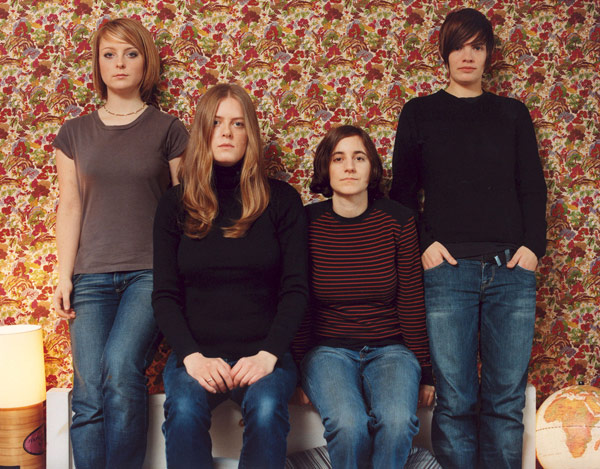
Electrelane


“Luminessence/Essence of the will/Time and fire/Turning burning still/Upon the hour table /Dreams of light are laid/But I’m not sleeping.”

- ‘Light’, Meat Puppets

I know a guy who loves Electrelane. That's understandable. I mean, what’s not to love? Thing is, the guy’s a misanthrope. He seems to have little faith in human nature, or the concept of love, or the redemptive quality of random acts of kindness. He is ‘into Crowleyian magick’ yet fails to divine the magical properties in a smile or a kiss, or even sex. All the world is merely grist to his dark Satanic mill. So here’s what I don’t understand: he dwells in darkness, whereas Electrelane largely trade in...
LIGHT! The same light eulogised by the Meat Puppets on their neglected 1989 classic, Monsters. The blinding flash, the eternal flame of illumination, the white-out, the O-mind. Sunshine through stormclouds, the silvery glint of a Greyhound bus, the shimmer of the sea in mid-July. Y’know, that kind of thing. How, then, can a misanthrope love Electrelane? Their music may have undercurrents of darkness, of mystery, but it’s so alive, so free and so fucking optimistic. It travels. It gets out a bit. It makes new friends. It feels a tug of remorse when it has, inevitably, to leave town. But it stays in touch.
Electrelane’s new record, Axes, is for me characterised by the sheer joy it radiates. Not dumb joy, if there is such a thing, but joy at being alive and able to feel not only happiness but pain, loss, absence, fear and all the rest. And sadness doesn’t equate with darkness, by the way. It’s just a different kind of light, like the stroboscopic light that dapples your face on a long train journey in summer. I put it to Verity Susman, Mia Clarke, Emma Gaze and Ros Murray that the sheer amount of travel involved in being part of this band (originating in East Sussex, they now live, variously, in Berlin, Prague, London and Brighton) must contribute to the feeling of perpetual motion that characterises much of their music.
“I don’t think it’s a conscious idea,” replies Mia (guitar). “But I mean, we were travelling a hell of a lot last year. We were away a lot.”
Verity (vocals, guitar, keyboards) elaborates. “When you’re just sitting there staring out the window, with things going past... it probably stuck, it got lodged in our heads somewhere.”
There’s the sound of the train on ‘Gone Darker’, too, which you join in with as the song builds at the beginning. Do you enjoy all the travelling you do?
“I love it,” claims Emma (drums). “It’s my favourite thing.”
I mumble absently about the melancholy nature of travel, the feeling that you’re constantly leaving something or someone behind. This strikes a chord with Ros, the band’s new bassist .
“I was talking to someone the other day and they were saying that the saddest object is a suitcase,” she relates. “Which I thought was really funny, because I saw it a different way. Whenever I think of a suitcase I think of being really excited and happy. Then they said that, and...”
They ruined it for you.
(Laughs) “It depends on what colour it is.”
I wonder if I’m wrong to hear so much exuberance and delight in Axes. Perhaps I’m hearing what I want to hear, screening out the parts I’d rather not confront, like I know I often do in the ‘real’ world outside of music. Is mine a wilfully inaccurate impression, then? Could it be the side effects of the Cipralex? Or perhaps it’s the upside of all this motion: constantly in the process of getting somewhere and thrilled by the prospect of never actually arriving. I used to want to live on a train. I was only put off by the fact that even trains have to stop sometimes.
“It’s like you were saying about travelling, that it’s where sadness and happiness kind of cross, and yeah, I totally agree with that, ‘cause it can still be sad and celebratory at the same time,” says Verity. “I think we get a kick out of when it’s quite sad, and then making it really happy; like, how can you get out of that minor bit into the happy part again.”

Axes was recorded largely live, in one room, the band able to look each other in the eye as they played. If Electrelane weren’t so active in rewriting rock, this would come across as somewhat clichéd, the kind of thing tired old hippies, punks and vinyl obsessives love to harp on about. But Electrelane make it all seem so new and inviting, and no, not because they’re female but because they’re still growing as a band. They’re still seeking and striving on their third album, the point at which most bands find themselves apologising for their recent past and going back to basics in an altogether less becoming fashion.
“Because we were all recording in one room, it was impossible sometimes to replace one part, so most of the time we kept the basic tracks, the live take of everybody playing together even if there were mistakes here and there. In the past we’ve been more neurotic about ironing any little inaccuracies out. This time we didn’t really think about that and I think the freedom in the songs is much stronger than on the last album.”
This may have something to do with Verity coming into her own as a lead vocalist. On ‘Two For Joy’ she conveys pure emotion so forcefully and unaffectedly, you’re knocked back for a moment; you don’t quite know how to react. Her delivery is blissfully uninhibited, flawed and unaffected in its soulfulness. When the song reaches its peak and Susman’s excitable whoop (possibly the most rock ‘n’ roll thing you’ll hear this year) gives way to a final, valedictory burst of Farfisa organ, you’re finished. There’s a new confidence there, but also something greater, an open-heartedness that transcends the vagaries of that most elusive yet overrated of commodities, ‘cool’. Which means that while Axes will kick your arse no problem, it’ll kick you even harder in the heart.
“I think the vocals this time were easier to do because we toured so much last year, so I just got used to singing a lot,” Verity states. “And then when I went in to record I had a much clearer idea of how I wanted the singing to sound. I tried not to do too many takes and it was normally the first one that would be the one that I’d keep. With singing, more I think than with anything else, once you start repeating it over and over again it starts to become laboured.”

From listening to the records and talking to the band, it seems that Electrelane’s methodology revolves more and more around the removal of the unnecessary, anything that could be interpreted as contrived, or as Verity puts it, “laboured”. But in paring back the components of their sound to the bare essentials, they are able to maximise the emotional impact of what’s left in. In keeping with this, all additions are made judiciously, not frivolously (like the hint of klezmer that suffuses the giddily romantic ‘Eight Steps’) In Mia’s words, Axes is “clearer” than their previous records. The sound is still dense, but it breathes. This breathing space is clearly precious to Electrelane; Verity frequently uses the word ‘freedom’ when expressing her happiness with the new material. Given that improvisation forms the basis of Electrelane’s aesthetic – all the songs on ‘Axes’ started out as jams – I ask whether the band intend to pursue this freedom even more when they play live.
“I think we’re gonna improvise a lot more on stage than we have done in the past, just because we’ve done so many tours,” she states. “I think we’re probably more confident now, playing together and playing live, to be able to risk something completely messing up (laughs).”
But would you ever consider doing something completely free?
“I think that’s what we wanna get to. Yeah.”
“But not totally improvised. I would shit myself!” laughs Mia. “Like, we played in Austria with Tony and Andy from The Ex, and obviously we hadn’t rehearsed or anything, and they were like, ‘Oh yeah, we’d really love to come on and play’ and it was like ‘OK, cool!’ [nervous laughter] I mean, I enjoyed it, but only after the fact. While they were on there, ‘cause you’re so used to just hearing three other people...”
“They have very distinctive ways of playing,” says Emma.
“...so I’m trying to listen to the band, and then Tony and Andy were like, ‘Eek! Eek! Eek! Eek! Eek!’ with screwdrivers and everything...it was like, ’What’s going on?’ [laughs] It was fun, but it was very frightening.”
That Electrelane can admit to this fear makes them even more valuable. After all, fearless people are either mad (not their fault), stupid (not their fault either, but you can blame them for the success of Razorlight) or just plain fake (unforgivable in most cases). Fearless people are also rather dull, as they have little to lose and less to talk about. Electrelane are none of these things. Their music expresses humanity, frailty and the strength that comes from clinging onto light even in the darkest times. Perhaps that’s why the misanthrope loves them. And perhaps that capacity for love will ultimately redeem him. Here’s hoping.

Municipal Waste


"We love partying, we're very serious about that,” affirms Ryan Waste, guitarist/vocalist/hairy hottie with Richmond, Virginia thrash reanimators Municipal Waste. “We're serious about the music, man. And we're serious about the paycheque, hahaha! We're serious about fun. How about that?"
Municipal Waste are perhaps the third or fourth best thing to death in terms of escaping the sickening realities of life and embracing chaos. For all its communal nature, partying is a form of denial, inevitably so, because what is there to party about really when one takes in the constant bomb threat modern life has become? Partying is about denying reality you’ve been handed and creating your own, a responsibility-free zone. Selfish? You bet. It isn’t party for your right to fight, as Public Enemy once detourned their labelmates, The Beastie Boys. It’s party for your right to party. Harder than ever. Til it hurts.
So as the world gets shittier, the grimily hedonistic hi-energy buzz of thrash metal is understandably enjoying a criticial and commercial resurgence. The surprise about this revival is that it seems to be throwing up a few bands who sound vital and venomous enough to survive the fickle attentions of the music media (ourselves included). Nottingham’s Earache have smartly bagged three prime movers; Huddersfield’s Evile, Merseyside’s awesome SSS and the big bros of them all, Municipal Waste. The latter’s three full-length albums to date, Waste ‘Em All (2003), Hazardous Mutation (2005) and the new The Art Of Partying may bring to mind the spotty, split-ended Metallica that recorded Kill ‘Em All, the DRI that unleashed Dealing With It and Crossover and especially the Exodus of Bonded By Blood, Pleasures Of The Flesh and Fabulous Disaster, but they hardly sound like a tired, money-minded re-run of something that worked better twenty years ago. And in person, they seem 100 per cent sincere - these dudes shit metal, which is probably uncomfortable, but they seem happy enough, considering.
"I think metal got pushed over the edge,” says vocalist Tony ‘Guardrail’ Foresta, a likeable fellow whose face habitually forms what can only be described as ‘a shit-eating grin’. “Like in the past five to ten years, it got shitty, and then it got shittier, now you got dudes dressed as girls wearing fuckin' make-up playing fuckin' screamy breakdowns, and all these people who grew up listening to Priest and fuckin' Slayer look at it and it's like, 'What is this bullshit?' Y'know?"
"I think a lot of those bands, they write the music and it's just kind of accepted that you write lyrics about violence and dark imagery,” states bassist/vocalist Philip ‘LandPHIL’ Hall. “They're just like, 'Ok, whatever...' and just pump out a bunch of lyrics. It's just kind of accepted if you have a death metal band then you write about gore, y'know? So they're just like, 'Alright, we'll write about gore...'"
"The funny thing is,” continues Ryan, “when we write about gore, people just laugh at it. Our shit's gory as hell! If you really read the lyrics it's like, 'Damn, that's kind of negative!' But everyone's laughing about it, because we're just having fun with it."
At this point in the interview, I think about what I’ve heard from other music journalists about Municipal Waste. Apparently, some interviewers have found the band hard work, too boorish for their delicate sensibilities, too keen to proselytise on the joys of cheap terror, good beer and nice tits. I can see why some might find all this a little lowbrow for their tastes. But would it be too blunt to suggest they pull the baguette out of their arse and loosen up a little? Let’s look again at that list: cheap terror, good beer, nice tits. Fuckin’ hell. What’s the problem here? Now, beer is righteous (hmm... kinda) but why talk about it when you can drink it? I decide to skip over that and aim straight for the terror and tits. Priorities, right?
So what films inspire the lurid goo-spattered vistas of Municipal Waste tunes?
Tony: "Repo Man."
Ryan: "We sample that on one of our old records. It's a classic."
Have you seen Tarantino and Rodriguez’s ‘Grindhouse’ double feature yet?
Ryan: "I like ‘Planet Terror’, the first half of it. That one smokes the other one.”
Tony: "I like them both. I think the second one, the Tarantino one could have been edited by about 20 minutes."
Ryan: "The dialogue was just annoying. It's a man writing women's dialogue and he didn't know what the fuck he was talking about."
LandPHIL: "Totally."
Ryan: "The first one was just so over the top. If we could make a Waste video that looked like 'Planet Terror'... I mean, the toxic element's there."
LandPHIL: "Lots of green, lots of gore, hot chicks!"
Ryan: "Choice use of cursing like in old '70s movies... 'Shee-it!' Hahaha!"
Dave Witte: “Those dudes are in love with the original ideas, the history. Which is kind of close to what we're doing. Everything has been manipulated and bastardised, but we go to the roots of it. A lot of people don't recognise the start - it gets lost. Then the bands get shitty, people get bombed out. It's all cycles."
Drummer Dave Witte (ex-Discordance Axis/Burnt By The Sun) is vaguely reminiscent of Jeff Bridges’ character The Dude from the Cohen Brothers’ ‘The Big Wachowski’. His manner is similarly laidback yet authoritative, and he clearly commands respect from the rest of the Waste. However his attempt at steering the interview at least part-way towards music is only partly successful.
Ryan: "We wrote a song about ‘The Thing’. 'Blood Hunger' on Waste 'Em All is about 'Blood Diner', a bad movie that I just can't stop watching."
LandPHIL: "'Leprechaun In The Hood'."
Um... what’s that about?
Ryan: "A leprechaun's in the hood and he's hanging out with rappers, he's doing bong hits and he kills someone with a bong, he gets locked in the fridge and he just smokes weed..."
Tony: "They did 'Leprechaun In The Hood' as part five of the ‘Leprechaun’ series and it was so popular that they did a sequel to it... so it's like a sequel of a sequel, hahaha!"
Ryan: "And you forget it's about a leprechaun, man, it's just like a hood movie or a gangster movie. But then it's like, 'Woah, a little leprechaun! And he killed somebody!' Hahahaha!"
Given your collective interest in cinema, what are the chances of a Municipal Waste feature film?
Tony: "I was talking to Ryan about that a little while ago, I said, 'I just think we should write a fuckin' script!' It would be awesome."
Ryan: "We might work with [infamous Troma founder and cheapo filmmaker extraordinaire] Lloyd Kaufman for a video. He's interested."
Tony: "There won't be any CGI in that shit! Hahahaha! 'We got ketchup...' Hahahahaha!"
LandPHIL: "Man, the cornier the better when it comes to special effects and shit. To see Tony, like, rip out his guts, even if it looked bad, it would still be so badass."
Tony: "I'll rip out your guts! Hahahahaha!"
Something at this point - can’t quite recall what - leads me to believe that it would be a good idea to admit that I have repeatedly masturbated to Stuart Gordon’s supremely trashy 1988 Lovecraft adaptation, ‘From Beyond’. Whatever the reason, it does seem to steer the conversation towards tits, as planned. Result!
Tony: “He jerks off to ‘From Beyond’! Hahahaha!”
LandPHIL: “Did you ever masturbate to ‘Basket Case’ too?”
To ‘Basket Case 2’? No. Never seen it.
LandPHIL: “Horror movies were where I saw my first titties as a kid.”
Ryan: “You know it’s good if there are tits in the first or second scene. That’s a horror rule.”
Tony: “Our next video’s gonna have tits. I insisted on it.”
Ryan: “Our last video, there were tits after the shoot.”
Tony: “Yeah, there were.”
LandPHIL: “There are titties on the new album.”
Tony: “They’re gross, hahahaha!”
Ryan: “We poured blood all over them.”
I think I’m growing my own right now. It’s a bit of a worry, really.
Tony: “Hey we’ve been in Europe, man. That beer’s thick, dude! It’s killer.”
LandPHIL: “We saw this band in Australia and all of us were like, ‘Woah!’ This one dude was playing bass and he had the biggest tits I’ve ever seen on a dude. Everybody in the audience was like, ‘Look at the tit meat!’”
Tony: “But he didn’t give a fuck, man, he took off his shirt and he had man tits. Wear the man tits proud. Juggle ‘em out, man! Show ‘em what you can do with those things.”
Thanks, Tony. I will.

Black Sabbath


Pouring rain, rolling thunder, a church bell tolling in the distance. Already you are in a cold and lonely place, shivering as the downpour soaks you to the skin. The last train left hours ago, there’s nowhere to shelter from the storm except beneath the bare branches of gnarled winter trees. The sleeping village mocks you with its inhuman silence. Then, out of nowhere, three notes from a Gibson SG echo the doleful rhythm of the tolling bell and your fate is sealed, all hope of escape fading fast. You're doomed[$italics].

"What is this that stands before me?/Figure in black which points at me."

The opening title song of Black Sabbath’s 1970 debut album witnesses blues-influenced rock 'n' roll giving way to something darker, harder, thematically more phantasmagorical and baroque yet structurally more primal and neanderthal. With three notes strung together utilising the notorious Devil's Triad or tritone - an interval spanning six semitones, banned in the middle ages for its allegedly diabolical properties - guitarist Tony Iommi, vocalist Ozzy Osbourne, bassist Geezer Butler and drummer Bill Ward departed from the more traditional blues-based rock of contemporaries such as Blue Cheer and Led Zeppelin and set to work on the pitch-black cauldron of weirdness and wonder that is Heavy Metal. While the aformentioned bands undoubtedly contributed to the foundation of the genre, Sabbath were the first fully-formed metal band, and they alone lay claim to being the originators of one of its hardiest and most adaptable subdivisions. Doom. The torpid, dragging tempos, the sudden accelerations, the sonorous, sustained chords, the lyrics of unremitting misery... all the elements fell into place with this one song.
Every permutation of doom - from the genre’s inception in the early ‘80s via Trouble, St. Vitus and Candlemass, right up to the present day - can be viewed as having been derived from the innovations of the classic Sabbath line-up. True doom, funeral doom, sludge doom, drone doom, all of these draw from the blackened wellspring of Iommi and co, each being magnifications of specific elements of the early Sabbath sound. Bands as varied as Solitude Aeturnus, Cathedral, Sunn 0))), Unearthly Trance, Saint Vitus, Corrupted, Sleep, Confessor and Reverend Bizarre owe their very existence to these hallowed masters of misery. Whether they focus on atmosphere, thematic grandiosity or simply slow, downtuned riffing, the shadow of Sabbath hangs heavy over these acolytes of doom.
But if it hadn't been for a factory accident that left riffmaster general Tony Iommi without two of his fretting fingertips, doom as we know it might not exist at all. Unable to comfortably play a conventionally-tuned guitar, Iommi opted for a lower tuning which elicited a deeper, heavier tone from his SG (Geezer Butler also downtuned his bass in order to play along) while the looser strings made pitch-bending an easier option. Filtered through a post-Hendrix/Yardbirds prism of volume and distortion, Iommi's fluid, jazz-inspired playing took on new extreme qualities ranging from the queasy and vertiginous to the oppressively monolithic, setting Sabbath apart from their contemporaries on the British club circuit and proving massively influential on the doom generation to come. As veteran UK rock critic Simon Reynolds points out, “Even in manic mode, Sabbath always sound depressed. Tony Iommi's down-tuned guitar, in tandem with the awesome rhythm section of Bill Ward and Geezer Butler, creates sensations of impedance and drag, like you're struggling through hostile, viscous terrain, the weight of the world on your shoulders.” This serves by extension as an accurate description of the physical and psychological effects of doom. Like codeine, weed and alcohol, doom is a highly addictive depressant. It enables the listener to let themselves go, but not in the accepted sense of disinhibition and party-hearty positivity. Rather, it offers an opportunity to discover just how low as you can sink without hitting rock bottom, to wallow in the negative aspects of life without the risk of self-annihilation.
When discussing Black Sabbath's influence on the doom metal genre it is absolutely vital to acknowledge the insane howl and gonzoid presence of one John ‘Ozzy’ Osbourne. An ex-burglar and all-round delinquent, Osbourne made a rather unorthodox rock star. No tousled sexbomb in the Robert Plant mould, and by no means the best singer in the world, Osbourne was nevertheless blessed/cursed with an untutored yowl that mirrored the band’s capacity for fearsome intensity and cosmic gloom. Ozzy's voice was sick, weird, baleful and defiantly unsexy, a sharp contrast to from the priapic yowl of the typical ‘70s hard rock frontman. His lugubrious tones achieve an especially chilling effect on the band's darkest, doomiest songs. When Osbourne screams "No, no, no, please God help me!" on ‘Black Sabbath’, he expresses one of humanity's deepest and most persistent 'irrational' fears - that of eternal damnation - with a conviction few contemporary death-grunters or emo-screamers could ever approach. Osbourne was also adept at playing the part of Satan, as such in-character songs as 'Lord Of This World' and 'N.I.B.' illustrate. Ozzy delivers the cautionary lyric of the former with diabolical glee ("Your world was made for you by someone above/But you choose evil ways instead of love") while the latter, Geezer’s tale of redemptive love between Satan and a mortal woman, indicates one of Ozzy’s greatest achievements as a vocalist; that of locating the human in the uncanny, making it even more terrifying in the process. Many a doom wailer has sought to emulate Osbourne's distinctive style, including Bobby Leibling (Pentagram), Scott 'Wino' Weinrich (Saint Vitus/The Obsessed/Spirit Caravan/The Hidden Hand) and Messiah Marcolin (Candlemass). All these singers have their individual merits and are influential figures in their own right, but it’s impossible to overstate their debt to the original Voice Of Doom.
So, what compelled Ozzy and his compadres to make such an unholy noise? In order to answer that question it’s necessary to look at the context from which the band emerged. Black Sabbath formed during a period of cultural flux, the point at which the colour began to drain from the psychedelic ‘60s. Coming from Aston, a grimy suburb of Birmingham blown apart by German bombs during World War II, Sabbath had little truck with the facile ‘peace ‘n’ love’ platitudes of the hippy dream. As Ozzy told biographer Steven Rosen, “We got tired of all the bullshit - love your brother and flower power forever, meeting a little chick on the corner and you’re hung up on her and all this. We brought things down to reality.” The late ‘60s and early ‘70s presented people with the flipside of the hippy dream, a brutal era of disappointment and distrust encompassing Altamont, Vietnam, the Watergate scandal and rock star corpses left, right and centre. Sabbath were one of the first bands to capitalise on the new pessimism and amplify the despair of their beloved blues to cosmic extremes. Although the occasional glimmer of hope shone through songs such as 'Children Of The Grave' and 'Sabbra Cadabra', Sabbath’s response to this world gone wrong was typically disengagement ('Sweet Leaf', 'Tomorrow’s Dream', 'Hole In The Sky') or outright disgust ('War Pigs', 'Killing Yourself To Live', 'Sabbath Bloody Sabbath'). This uniquely slothful brand of misanthropic angst runs like a stagnant river through the six albums spanning the period 1970 to 1975.
'Black Sabbath', 'Paranoid', 'Master Of Reality', 'Volume 4', 'Sabbath Bloody Sabbath' and 'Sabotage' are considered by the majority of Sabbath devotees to represent the real Black Sabbath, and rightly so. Over the course of these albums the band redefined what it meant to be ‘heavy’. Previously this was a vague term employed by hippies to describe anything meaningful or intense. In this sense, ‘Heavy’ might encompass anything from Pink Floyd and Yes to Traffic and The Grateful Dead. But Black Sabbath made music that was devastatingly heavy in form, content, execution and effect. The churning guitars and piledriving rhythms were more powerful and focused than anything else rock ‘n’ roll had to offer at that point and the utter despair of the lyrics contrasted sharply with the tales of topographic oceans favoured by the flouncy art-rockers of the time. Although the debut album constituted a formidable opening statement, their metallic sound would become fully realised on 'Paranoid', released later that same year. Extended instrumental jamming gave way to tighter songs written around slow, repetitive riffing and simple melodies. 'Iron Man', 'Hand Of Doom' and 'Electric Funeral' further refined the proto-doom of the previous album’s title track, reigning in the band’s excesses yet maximising their apocalyptic heaviness.
1971 saw the release of the third Sabbath album, 'Master of Reality'. Often considered the definitive blueprint for all doom metal, it’s also the band’s most consistent collection of songs. What self-respecting doomhead could argue with the descending stoner-riff of 'Sweet Leaf', the galloping charge of 'Children Of The Grave', the demiurgic belch of 'Lord Of This World' or the intergalactic trawl of 'Into The Void'? Tony Iommi has since expressed reservations regarding the album’s production, but in truth Master Of Reality sounds utterly astonishing to this day, a thick, muddy quagmire of majestically dragging riffs, head-smacking rhythms and unhinged prophet-of-doom vocals. Perhaps one of the reasons it sounds still sounds so contemporary is that it has been so ruthlessly plundered by countless doom metal bands, most of whom could only dream of achieving similar levels of cosmic melancholy.
1972’s ‘Volume 4’, though worshipped by many, seems something of a retreat from the troglodytic momentum of the previous record. Hints of jazz, blues and boogie creep in here and there, recalling the syncopated swing of the Earth years. That said, the tracks in which these influences are most conspicuous -'Tomorrow’s Dream', 'Supernaut', 'St. Vitus’ Dance' - are awesome pieces of music featuring some brilliantly infectious riffing from Iommi. The doom element of Volume 4 is provided by 'Snowblind', 'Wheels Of Confusion', 'Cornucopia' and 'Under The Sun', tales of pain, insanity and drug abuse set to riffs of ludicrous weight and girth.
Perhaps understandably, having sold doomloads of records, toured the world and gained access to ever more sophisticated recording facilities, Tony Iommi felt the urge to branch out. This desire may also have been inspired by the fact that with the exception of US legend Lester Bangs and a few others, rock critics hated the band, viewing them as somewhat retarded in comparison to the more cerebral likes of Yes and King Crimson. Hence 1973’s 'Sabbath Bloody Sabbath' saw the introduction of mellotrons, moogs and orchestras in an effort to expand the band’s musical horizons. It worked. If there was ever a metallic equivalent to the ornate 60s pop of late-period Beatles and Beach Boys, this was it. Not only that, but Sabbath had managed to retain their crucial heaviness. The title track, 'A National Acrobat' and 'Killing Yourself To Live' are key doom texts, the latter featuring the single most depressing lyric of Sabbath’s career (“Just take a look around and what do you see/Pain suffering and misery/It’s not the way that the world was meant/It’s a pity you don’t understand”). Curiously enough, the album’s most audacious experiment was written by Ozzy. The slow, grinding tempo and insistent riff of 'Who Are You' were nothing new but the substitution of moogs for guitars was an unexpected stroke of genius, predating the synth-based space-doom of Italian mentalists Ufommamut by over 30 years.
1975’s Sabotage continued in this experimental-yet-brutal vein, with Iommi piling on the synths and keyboards and even embellishing the industrial-strength riff of 'Supertzar' with a Russian choir. But there were also a couple of future doom standards amongst the kitchen-sink excess. The rabid retreatism of 'Hole In The Sky' would inspire a deranged cover by North Carolina eccentrics Confessor in 1992, while the bruising opening riff of 'Megalomania' harked back to the primal sludge of the ‘Paranoid’ album. Though not strictly doomish - in fact more reminiscent of The Who at their most symphonic and progressive - the stately pace and skull-crushing heaviosity of closing epic 'The Writ' illustrated that Iommi’s growing eclecticism did not necessarily entail any loss of power.
Sadly this wasn’t the case with Sabbath’s final two albums with Ozzy, 1976’s 'Technical Ecstasy' and 1978’s 'Never Say Die', records seldom referenced by anyone, let alone doom metallers. Although both deserving of critical reappraisal if only for their frequently mind-buggering strangeness (Funk? Horn sections? Bill Ward singing?) these records were the sound of the Black Sabbath’s original line-up unspooling. On Technical Ecstasy, the opening riff of 'You Won’t Change Me' carried all the dread and foreboding of earlier works, and 'Dirty Women' would become a staple of their live set upon reuniting in 1997, but these were isolated links to a glorious past. Similarly, 'Never Say Die' would have been a great rock album by any other band, but it completely lacked the combination of punkish aggression and skin-crawling atmosphere which had made the earlier albums so enthralling. Before long Ozzy was out and the nightmare was over. For a while, at least.
As with most influential groups, there was more to Black Sabbath than just the music. Doom metal’s visual aesthetic - skulls, crucifixes, religious iconography and gothic imagery - also owes a great deal to the band’s gloriously morbid image, masterminded by Geezer Butler. The band had been labouring under various names including Polka Tulk Blues Band and Earth until, as legend has it, Geezer clocked the title of a Mario Bava film and suggested a name and image change to his bandmates. His contention was that people paid good money to be scared shitless by horror films, so why not apply the same logic to rock ‘n’ roll? This idea was not entirely without precedent - Screaming Lord Sutch and Screamin’ Jay Hawkins spring to mind - but the embryonic Black Sabbath embraced the grand guignol aspect in a much more substantial manner, dressing in black, posing with skulls for publicity photographs, playing songs with occult themes and cultivating an atmosphere of darkness that established doom metal’s ongoing flirtation with all things morose and macabre.
Despite the fact that many Sabbath songs explore the character of Satan and deal with themes of death, madness and torment, lyrically, Sabbath were far from 100% evil. The sentiments expressed in songs such as 'After Forever' and 'Lord Of This World' are entirely consistent with Christian philosophy, and may even sound a little preachy to modern ears. It's therefore no coincidence that doom metal is similarly preoccupied with sin, repentance, redemption and damnation, as the works of Candlemass, Pentagram, Cathedral and Trouble illustrate. Pentagram's 'All Your Sins' is an almost parodically pious warning of the bad shit to come if one refuses to repent ("You're gonna BURN now!"), the early work of Christian doomheads Trouble is awash with titles such as 'Psalm 9' and 'The Tempter' and Candlemass even attempted their own account of the Old Testament with 1989's 'Tales Of Creation while vocalist Messiah Marcolin pranced around in a monk’s habit. Fear of God and Devil form an important ingredient of the doom worldview. Whereas death and black metal often concern themselves with the pros and cons of antisocial behaviour such as mutilation and church-burning, doom is more concerned with the relentless torment of existence and the terrible punishment that awaits at its end if you fail to bear the weight of wordly misery with good grace. Doom is therefore a deeply moral strain of metal. As Sunn 0)))’s Stephen O’Malley points out, the word ‘doom’ derives from the Anglo-Saxon ‘dom’, meaning judgement or law, referring to an unavoidable fate. Or, more specifically, punishment from God.
Black Sabbath's early work is permanently enshrined in metal legend. But can any of Sabbath’s later albums be said to have had any influence on the development of doom? Most attempts fill Ozzy’s platforms have drawn sniffs of derision, especially on albums where Iommi is the only link to the classic line-up. But while the Dio era receives recognition for such doom-defining artefacts as 'Children Of The Sea' and 'The Sign Of The Southern Cross', there are also occasional echoes of former glories in Sabbath’s post-Dio, pre-reunion wilderness years. 'Zero The Hero' (from 1983’s 'Born Again') is perhaps the finest example of this, featuring two of Iommi’s finest, most cataclysmically evil doom-riffs, as well as a crazed performance from Ian Gillan. The Glenn Hughes era is perhaps best ignored ('No Stranger To Love'? No thanks) but skipping ahead to 1994's 'Cross Purposes' we find the dejected dirge of 'Virtual Death'. The single most impressive product of the Tony Martin-fronted era, this eerie crawl sticks out like a severed digit amongst the disappointingly uptempo numbers that characterise the rest of the record.
Jumping back a couple of years, 1992’s 'Dehumanizer' is possibly the most overlooked entry in the entire Sabbath canon. This ultimately failed attempt at a reconciliation with Ronnie James Dio is notable for being the most doom-laden album the band had released since the Ozzy era. 'After All (The Dead)', 'Letters From Earth' and 'Computer God' all boast monstrous riffing and Dio singing in a more aggressive style than usual, even letting loose a couple of Ozzyisms now and then (check his “Allll-riiight!” on 'Letters From Earth'). However unsatisfactory for the singer, the experience seemed to provide his solo career with a much needed shot of adrenalin. Dio’s subsequent 'Strange Highways' and 'Angry Machines' albums were to be the heaviest - and doomiest - of his career.
Instances of latterday greatness aside, it cannot be denied that the fundamentals of doom metal were established by those first six albums and the dark magic created by Iommi, Osbourne, Butler and Ward. Better musicians may have passed through the ranks, but the chemistry between those four stoned and angry young men from Aston has never been equalled. Are Black Sabbath the spiral architects of doom metal? Without a doubt.

Strapping Young Lad


“You can only write what you can write and each year brings a different set of circumstances to the table that result in different types of music, right? ‘Alien’ was that year and ‘The New Black’ is this year.”
That’s Strapping Young Lad mastermind Devin Townsend, responding to the question ‘Did you feel any pressure in producing a follow up to ‘Alien’?’ His stock answer is delivered politely and professionally, but there’s a hint of boredom and frustration detectable through the layers of telephone fuzz. Unexpectedly, and within the same breath, that hint suddenly becomes the basis of the entire interview. The gist of it being, Devin’s in a rut, and he wants out. Surprised? Well... yeah[$italics].
“At the end of the day, man, I’m just tired, and old, and bald, and fat, and grouchy, and bored. You know? So I was just like, I’m going to make this record, and do this stupid Ozzfest thing, and tell a bunch of stupid jokes in front of a lot of people at Download, then I’m just going to fuck off for a while.”
Needless to say, this isn’t the kind of talk you would expect from an artist with a new album to promote, supported by a series of high profile festival dates. What exactly is going on here? Does Devin intend to exit the music business entirely? Or just put Strapping Young Lad out to pasture?
“I’ll be doing other projects,’ he answers. “But SYL was never supposed to be the type of band that played at Download or Ozzfest. Here we are doing it and I’m just like, ‘WHAAAT?’ There’s a part of me that just wants to step away from it. The new album’s like, ‘Okay, well, we’re gonna be doing these big shows and doing the Ozzfest... alright, I’m going to write a sing-a-long record that essentially tells everybody that they’re idiots. Including myself.’ We’re all idiots, it’s all stupid. This record’s supposed to be a celebration of the idiocy that is this career.”
Devin Townsend has always approached the world of metal with a degree of laconic humour, but today he sounds exasperated. It seems the years of grinding through the music industry mill have taken their cumulative toll on our embattled protagonist.
“It’s been fifteen years of apathy and misanthropic views on life,” he explains. “The bigger this gets, the less I care, to the point where I just need to go spend some time with my family. I don’t wanna bastardise Strapping and all these other projects by doing it for the money. Strapping was about the big middle finger, and it still is, but I don’t think it needs to go any further than this. I’m always gonna be putting out music but I just need to put my guitar away for a while and step away from it. No matter how many people give you googly eyes while you’re on the stage, no matter how many people try and tell you that your band is really cool, or conversely, that your band sucks, at the end of the day it’s all a joke, and anybody who believes in it is just asking for trouble. I just don’t believe it. You know what I mean? Download? It was great! It was a lot of fun, right? ‘Feather in my hat, great, thank you very much...’ You can keep[$italics] it.
“I just don’t care[$italics],” he continues. “The record company are like, ‘Strapping’s on the rise! You guys have gotta sign for another fifteen records!’ And this started as a fuck you to everything! I don’t wanna be in a position where I’m like, ‘Fuck me[$italics]! Look at me! I’m a whore!’ You know?”
What might seem unnervingly close to self-sabotage is more likely indicative of Townsend’s keen instinct for self-preservation, and his unwillingness to become another dishonest shill pimping out a worn copy of his former self is actually pretty fucking admirable. He’s also refreshingly direct when called upon to survey the SYL ouevre.
“The best Strapping record was ‘City’,” he admits. “That’s not gonna change. I can do a hundred more Strapping records and I’m never gonna do ‘City’ again. A lot of people trumpet their new record as the best thing ever, but I did ‘City’ when I was 23 or 25, and at that point I truly felt it, I truly lived it, I truly believed it, as opposed to having to go there in order to have something to tour. That’s why I still feel like ‘The New Black’ is a valid piece of art, just because it’s like, ‘Alright, you want me to go there? Sing along! You’re an idiot! I’m an idiot! We’re all idiots!’”
While it might not scale the dizzy heights of SYL’s finest hour, ‘The New Black’ is an honest reflection of where Devin Townsend is at this moment in time. It’s a weird and bitter place, for sure, but don’t take Townsend’s current disdain for the rock ‘n’ roll circus as any indication that he’s lost the plot musically. “Artistically, it’s totally sound and I’m proud of it,” he states, and with good reason. The complex webs of cybernetic riffage that underpin songs like ‘Wrongside’, ‘Almost Again’ and the title track mean that ‘The New Black’ isn’t quite the dumbed-down, meatheaded metal album its chief architect might suggest.
However, were it not for the savage tech-metal fury with which it is delivered, some of the new material could be considered perilously close to the platitudinal. ‘You Suck’ and ‘Fucker’ are enjoyable slabs of rabble rousing mock-menace, but lyrically they’re entirely undemanding. Lest we forget, this is the guy who gave us such darkly confessional gems as ‘AAA’ and ‘Detox’. If Townsend is to be believed, he has written these specifically for rabid crowds to howl along to. Unfortunately, he also seems to have lost enthusiasm for touring, at least as far as SYL is concerned.
“It’s gotten to the point where it really interferes with my life,’ he explains. “Because not only don’t I care, now I have to not care for like, ten months of the year. Everybody’s got such a hard-on for touring, too. All these bands are like, ‘You know what I’d really like to do, man? I’d really like to get into a 40 foot steel tube, with fifteen men, drink beer and watch The Simpsons! For ten months! That would be great. Then for that one hour a day we’ll go up there and sweat, and pretend that it matters to our life personally that we can pretend that we’re rock stars.’ You know?”
Ironically, Devin’s lack of faith in the rock ‘n’ roll dream makes him a brilliantly entertaining frontman. His slyly sarcastic announcements at Download (“Down my fucking load, babies!”) punctured the pomposity of the event like a rain of tin tacks on an over-inflated balloon.
“You know what the best thing about Download was?” he laughs. “We watched the video after, and I blew a ball of snot out of my nose on the first song! It stuck to my cheek for the whole show. So I’m like, ‘Okay, here I am at the biggest show I’ll probably ever play, and I’ve got snot all over my face.’ I officially named the ball of snot ‘Herman’. You get to the point with your band after ten years where you’re finally able to play a show like that, and what do you see? You see this ugly, dirty, bald, old, fat, miserable fuck with snot on his face. There you go! Hahahahaha!”
According to Devin, he stumbled into his decade-plus career in heavy metal more or less an accident, and his subsequent inability to enjoy the superficial pleasures of the rock ‘n’ roll lifestyle means that he should get the fuck out. Right now.
“When I was a kid I was never like, ‘I’m gonna be a rock star! I’m gonna grow up and play my guitar in front of a whole bunch of people!’ I got out of school, I liked music, I was good at it, so I made a demo. The next thing I knew I was in LA. Here I am, fifteen years later, in an office in Germany, bitching and complaining about these great things that have happened. I’m just unappreciative, and therefore should not be allowed to do it.”
One thing that becomes abundantly clear from this conversation is that Townsend is thoroughly sick of seeing his own face plastered all over the music press. It’s perhaps easy to forget that Townsend is a musician - a highly talented one - first and foremost, and only grudgingly a ‘personality’.
“Believe it or not, I tend to be a rather private person. I don’t want people looking at me, I don’t want to be recognised, I don’t want to play the game, right? And because of downloading, you probably do the same amount of interviews and your face is in the same amount of magazines as maybe fifteen, twenty years ago, except you sell a tenth of the amount of records. So it’s like you get all the fame but none of the financial rewards, right? It’s like, if you really like fame, then again, I’m telling you man, this is the job for you. I have a baby, everybody knows about it. I fart sideways, everybody knows about it. I take pills for a very common mental ailment, everybody knows about it. For fuck’s sake, man! It’s impossible to kind of be alone and make music. If I could pay my rent by making music for me, my friends and a couple of people that I know here and there, man, I would do it.”
Although Devin has always been candid on the subject of his bipolar disorder both in his work and in interviews, he feels his reputation as the ‘mad scientist of metal’ has been blown out of all proportion. In essence, his attempts to demystify the condition have backfired.
“I’ve said this before,” he groans. “I’d say a good 60% of the English speaking world takes pills for some sort of thing, right? You can’t sleep, or you have crazy thoughts... we live in an industrial disease-ridden world, and you have to take steps in order to keep your equilibrium. But y’know, everybody’s so insistent on me being the ‘crazy guy’. I’ll take 50 photos at a photo shoot of me just looking normal. Then I’ll sneeze, and that one moment where my eyes are crossed and there’s spit coming out of my mouth and my teeth are all yellow, that’s when they’ll click the photo and they’ll put that on the interview and say, ‘He’s CRAZY!’ You know? The difference between now and fifteen years ago, is that would’ve sold you a lot more records then than it does now, because anybody who wants to hear Devin Townsend or Strapping Young Lad, or any band, they just have to punch it into the computer and there it is. You’ve got it for free. But that doesn’t change the amount of interviews and the amount of shows you have to do in order to get from point A to point B.”
So it’s maximum effort for minimum return?
“Yeah, but it’s not about the return,” flinches Devin. “The bottom line with my career is the art. Really. I love extreme art, I love extreme music for the sake of being able to convey extreme emotions, but... rock is stupid. I’m not a rock star, I never will be, but the whole facade and the whole image... it’s just stupid. Anybody who believes it is setting themselves up for a job in a pizza factory in ten years. We’re all the saaame[$italics]! Just because you’ve got fancy pants and sunglasses doesn’t make any difference when you’re crosslegged on the toilet, grunting out a curry shit at four o’ clock in the morning with your face pressed against the sink because you’re trying to find something cold to bring your temperature down. Everybody is an idiot, you know what I mean? I guess my problem with this whole rock ‘n’ roll thing is that they really try and convince whoever’s doing it that they’re not that person. That for some reason, you’re better, you’re more privileged, you’re smarter, you’re more gifted. So maybe if my career never does anything from here on out, the crowning moment of my entire career will be having a huge hunk of snot on my face at Download. ‘I’m an idiot! Thank you very much for coming! Buy a T-shirt!’”
So is this really the end of Strapping Young Lad? Does ‘The New Black’ represent the last gasp of a much loved metal institution? Or is this all some bizarre, elaborate promotional stunt? At the end of the conversation Townsend requests that we “take whatever I said with a grain of salt,” but the 34 year old Canadian sounds genuinely burnt out and pissed off. Only Devin knows what will happen next, and he may yet confound all our expectations. It wouldn’t be the first time.

Mordant Music


Summer 2006. I stumble upon an intriguing, teardrop-shaped CD sleeve in one of London’s bespoke audio boutiques. On closer inspection, I note that the CD features the voice of Thames TV continuity announcer Philip Elsemore, whose rich, comforting tones and crumpled, friendly face I had forgotten until this very moment. Ghosted. I scan the sleevenotes, a mossy manifesto conjuring images of Britain succumbing to corvidae while ‘the amplified sound of dead air’ leaks from melted transistor radios. I purchase the CD, but I’m discombobulated by its hyper-sampleadelic plundering of Britains past and present, its salty evocation of early ‘90s UK techno (Stakker, FSOL, Bandulu, et al) and crafty nods toward dubstep. I return it to the shop, mildly aggrieved.
But something isn’t right. In spite of myself, I’m still breathing Dead Air. I buy it again, and spend the rest of the summer, autumn and winter travelling up and down the Silverlink, binding the sound in my headphones to the concrete and pebbledash and undead, dreamless sky.
Admiral Greyscale and Baron Mordant are the shadow-hosts to Mordant Music, a constantly sporing subcultural entity which, as well as releasing the insidiously essential Dead Air, has spat out collaborative emissions with dubstep artist Shackleton (notably 2004’s now-classic ‘Stalker’ 7”) and comedian Simon Munnery (the pornographic View Mastur toy). I contacted the pair for a furtive electronic interview...

Why 'Mordant'? Does the aesthetic dictate the music or vice versa?

Admiral Greyscale: “I think the deathly aesthetic unquestionably fuels the art... it’s a beast that feeds on itself in perpetuity.”

Why is now the right time for a soft explosion of British Weird?

Baron Mordant: “We're right down to the marrow now in terms of yield and an exciting final finality is being viscerally heralded from all quarters, whether it be doom, dubstep, noise, folk or our own brand of death-throw archiving. It is certainly an overall period of mourning and a vast shedding of sonic skin. The glee club has finally departed and a realistic social interaction, imbued with a stark musical framework, has begun to infiltrate everyday lives... '1984' with a better soundtrack. Pound for pound the overall salvation factor is actually in rude health.”

Is Philip Elsemore pleased with the results of his participation?

BM: “A wonderful combination of ecstacy and reticence...'ecstaticence'.”

Is MM part of a British musical lineage?

BM: “MMore an overall cultural lineage that music is the host to... Chris Morris and Leerdammer are as influential as Aphex Twin. The lineage is cosmic and not confined to Broadstairs.”

AG: “We’re pretty keen on Tulse Luper (a fictional British raconteur invented by filmmaker Peter Greenaway). Leonard Rossiter is also a talisman.”

So how would you describe your relationship with good old Blighty? Is there a kind of patriotic pride to MM?

BM: “Blighted by shortsightedness more like. As cultures clash and dovetail, with only a handful of mavericks to applaud, I'm firmly opposed to patriotism. It's the vast unknown that I pledge allegiance to... I'm fed up of the forecourts.”

What influenced your decision to make each MM release a covetable 'item'?

AG: “We fumble in the wake of Mo Wax, 4AD, Factory and all those labels/artists for whom a visual identity is as fundamental as the sonic output. We’re also both collectors by nature to differing degrees. We approach the making of everything with an eye on whether or not we’d treasure the item ourselves.”

Given the amount of samples used on Dead Air, how did you decide what went in and what stayed out? Was there a particular 'feel' you were looking/listening for?

BM: “It distilled itself from a lifetime of influences somehow... the BM/AG 'Grey Library'. There were several phases of aligned creativity and it was certainly not just tossed off, however despite the convoluted processes both creatively and socially Dead Air can be looked upon as a veritable 'chicken in a bastard'... only the listener can decide to delve deeper or treat it as scree.”

AG: “We generally aim for a nuance, a vague notion of something... anything overly familiar tends to get lobbed overboard.”

How did the relationship between MM and dubstep come about?

BM: “Dubstep is somewhere in the MM tea-leaves albeit a peripheral cuppa. Sam Shackleton is a friend who happened to be making music in that vein. MM released 'Stalker' which defies the dubstep tag in my book. It's more John Carpenter to my ears. The recent 'I Want To Eat You' (available on double a-sided 10” with MM’s ‘Hummdrumm’) is certainly in dubstep's six-yard box. Sam's totally 'Mordant' and will breach our defences at some point again in the future.”

What do you feel MM's music shares with dubstep?

BM: “The burden! Note for note, not much, although I am into the tempo and convex production. I think it's suffocating itself and maybe that's the point. We certainly inhabit the same bitumen lined vacuum.”

Melvins


Thank fuck for The Melvins. While other bands chase their own behinds in the attempt to stay current, fall over themselves trying to placate their fanbase and generally forget why they started making music in the first place, Buzz Osborne (vocals/guitar) and Dale Crover (drums) keep on doing exactly what they want, when they want. It’s tempting to peg their new album ‘A Senile Animal’ as some kind of heroic return, featuring as it does some of their most infectious and accessible work to date, as well as new recruits Jared Warren (bass/vocals) and Coady Willis (more drums) aka Big Business. But with five album releases in the last two years, the fact of the matter is they’ve never been away.
“I’ve had people talk about ‘The last real Melvins record...’ I’m like, ‘Real[$italics] Melvins record?’ I have no concept of what they’re talking about," laughs Buzz. "If you put it out, it’s a real album! Considering how much time we put into that stuff, for it not to be a real record... y’know? I’d put the album we did with Lustmord, ‘Pigs Of The Roman Empire’ (2004) in our top five records because it covered ground that we hadn’t covered before. It’s the exact record that we needed to put out at that point.”
One only has to look at their recent projects - the Lustmord collaboration, two albums with Jello Biafra, a live remake of 1993’s ‘Houdini’ - to conclude that The Melvins are scarcely the most predictable of bands.
“God forbid,’ shudders the guitarist. ‘We can do straighter stuff if we want to. We can also do a lot of other stuff, which sets us apart from almost every other band. We can do just about anything any other band can do, but they can’t do what we[$italics] do.”
This (per)versatility has ensured that The Melvins have continued to be a vital musical force even as their more photogenic peers have fallen by the wayside. Or died.
“I’ve come to the conclusion that the reason most of our contemporaries were able to become famous is because they all had frontmen that looked like cute wounded junkies. Layne Staley, Kurt Cobain, Chris Cornell. And none of us could really pull that off. I honestly believe that if the singers from those bands were 300 pound black guys with the exact same voices, nobody would have bought their records.”
Despite their relative lack of commercial success, The Melvins are regularly cited as an inspiration by younger bands. Buzz views this with a degree of scepticism.
“Most of them miss the point. I’m not even sure what the point is. But they’re missing it.”
True. The Melvins are not an easy band to emulate. For one thing, they’re awesomely talented musicians. For another, they’ve never stopped trying new approaches to their music. This, after all, is the band that recorded ‘Gluey Porch Treatments’, ‘Lysol’, ‘Stag’, ‘Prick’ and ‘Colossus Of Destiny’. None of which indicate a band given to second guessing the requirements of their listeners.
“Well, if we did that people would hate us anyway. I’ve always said that. So I’m not afraid of doing things differently. I’m really, really happy with the new album... I'd put it in my top five as well!”
When discussing the new album, a curious thing happens to Buzz’s voice. It almost cracks into a giggle. While it’s hard to find an artist who doesn’t hail his or her latest work as the best thing they’ve ever done (aside from Devin Townsend) few seem so genuinely thrilled about their new work as Osborne does today. Especially after 20-odd years of making music. And he’s right to be. ‘A Senile Animal’ is a fucking great rock album just like Sabbath, Kiss or Cheap Trick used to make. It’s a hell of a lot heavier, of course, but just as concise. Six of its ten tracks clock in under the three minute mark, while the whole album lasts just over 41 minutes. Though prolific, The Melvins are firm believers in quality over quantity at a time when many bands feel the need to fill all 80 minutes of a single disc or - heaven forbid - present the listener with an interminable double disc opus.
“That’s ridiculously long. We always shoot for somewhere between 40 and 45 minutes. 50, max. It’s all I wanna hear.”
The recruitment of Jared and Coady following the exit of bass player Kevin Rutmanis was something of a thunderbolt for Melvins fans. The pulverising twin-kit charge of ‘A Senile Animal’ illustrates that it was in fact a masterstroke.
“I’ve been in this position so many times before," recalls Buzz. "You try to think of what you’re gonna do now. The last thing I wanted to do was just get somebody that fit the suit. I wanted something that was a little more out there. So we started thinking about people to play with and Jared’s name came up. We had played with Big Business before and liked ‘em. We’d also talked for years about adding another drummer. So I said to Dale, ‘Instead of just asking Jared, why don’t we ask both of them to join?’ He thought that was a great idea.”
Thankfully, the absorption of Jared and Coady into The Melvins didn’t result in the end of their own band.
“We insisted that they continue with Big Business. We wanted them to focus on that and play with us as well. And it worked out well. They moved from Seattle to LA, but they were going to anyway! We did a lot of work in a very short amount of time.”
On the subject of previous bass player Kevin Rutmanis and his eventual departure from the band in 2005, Buzz is tight-lipped but gracious.
“We hit an impasse as a result of personal issues. Let’s leave it at that. I honestly hope things work out for the best with Kevin and I have nothing bad to say. I don’t know what he’s doing. I don’t know what any of our ex-bass players are doing. Lori Black lives in San Francisco but I haven’t talked to her in about four years. Joe Preston, I have no idea. Mark D, I have no idea at all. Matt Lukin played with Mudhoney for a long time and then was completely out of music probably for five or six years. That’s it, y’know?”
Bearing in mind the number of bass players that have passed through the ranks, one wonders if Jared is a little worried about his job security...
“He better[$italics] be. None of those people would have ever quit. Regardless of what they think now. We never had anybody quit our band. They were booted, whether it was their fault or not. I actually liked all the bass players. I really liked the things that they contributed musically. Jared is outstanding by his being a lead singer as well.”
There’s no doubt that Jared’s vocals - uncannily similar to the young King Buzzo’s - add a certain depth and shade to the new material. One of the key moments on ‘A Senile Animal’ is the glorious choral section of ‘A History Of Bad Men’. It’s a brilliant example of the secret pop heart that beats beneath The Melvins’ crusty carapace. It also sounds a bit like classic Queen.
“That’s what happens when you have someone who can actually sing with the band,” sighs Buzz.
The final song on the album is entitled ‘A Vast Filthy Prison’. While the title might suggest a somewhat Gnostic perspective on the world, perhaps inspired by the work of science fiction author Philip K. Dick (who coined the phrase ‘Black Iron Prison’ in his mindblowing semi-autobiographical novel ‘Valis’) it is in fact an oblique summary of Buzz’s philosophy of self-determination.
“It’s about a prison for the self. It’s something you’ve built. You’re now in it and it’s beyond your imagination. You can’t blame the world for it. Basically it’s about desperation and being stingy. Demanding things while looking like you’re being benevolent, but you’re really not. That’s as close as I can come to where it’s actually at.”
Buzz warms to this theme.
“We are personally responsible for our own destiny. You have to make things happen on your own terms. If you’re gonna sit around and wait for somebody else or the government to do it for you, you’re an idiot. People who wanna sit there and blame the way the world is for all their woes, I have no hope for them. Most of these people can’t even pick a good band to listen to, let alone comment on what’s going on in the outside world. Or monied celebrities trying to tell me what I should do with my money? Fuck that. They should all be hanging by their necks. ‘Save Africa!’ First, find Africa! ‘Save Tibet!’ Fuck[$italics] Tibet! Find it on the map, now tell me why you care about it. Fuck that, I have no interest. If there are celebrities involved and they have some interest in it, then that is exactly why I am not interested in it. Brad Pitt talking about Africa... fuck that. Fuck[$italics] Africa. If he’s involved there’s gotta be something wrong.”
The Melvins are isolationists, having always existed in their own private universe, aloof from any current scene or trend. And Buzz likes it that way.
“It’s self-inflicted,” Buzz explains. “That’s always been the case throughout our career. There’s no golden era. I lived through all those eras and if people wanna look back on all that stuff as the good old days, they can go right ahead. I’m looking to the future, y’know?”

Mastodon


“Take away the anchor/Amplify the mystery” - ‘Capillarian Crest’

“Baba Yaga.”
Brann Dailor, Mastodon drummer and tattooed love boy, picks his favourite mythical creature.The decision takes him roughly half a second. Like fellow bandmates Troy Sanders (bass/vocals), Brent Hinds (guitars/vocals) and Bill Kelliher (guitars/vocals) he’s intimately acquainted with the everlasting power of myth. After all, Mastodon only grudgingly exist in our world. They’d rather be elsewhere. Where the wild things are...
“She’s a badass evil Russian witch,” he continues, enthused. “She has a run-in with these kids in the forest and she’s got this crazy fuckin’ thing she flies around in. All those Russian fairytales they paint on the little tiny black lacquer boxes? They’re so cool. My wife went to Russia, and there were these people painting these boxes with little tiny brushes, working at ‘em for weeks and selling them for less than ten dollars. People are really poor over there right now. We fucked ‘em up good. ‘Yeah, be democratic, it’s great! Oops! It failed. Sorry about that. Build some bombs, alright?’ The mob are runnin’ shit over there.”
“I still wish they would find Bigfoot,” admits Troy, bashfully.
“Yeah,” agrees Brann. “Where is that motherfucker?”
Mastodon have just released their third album. It’s entitled Blood Mountain and what can I say about it but... oh my God, the RIFFS!!! There are few bands throwing riffs of this quality around with such reckless abandon right now. Brann and his merry band of explorers have taken the hyperkinetic heroism of their previous two albums Remission (2002) and Leviathan (2004) and twisted it into a Mobius comic strip populated by crazed mutations such as the Cysquatch (“a one-eyed sasquatch that can see into the future,” explains Brann) and the Birchmen (probably not members of American Anti-Communist organisation The John Birch Society). It’d all be impossible to absorb were it not for the fact that each and every one of the fucking things is catchier than a Cenobite’s flesh-hook, making Blood Mountain as much a total POP experience as an object lesson in the art of shredding. These riffs are so maddeningly infectious, they drove Brann Dailor crazy before he’d written them.
“You can’t control what riff is gonna come to you when and where or what’s gonna inspire it,” drawls the drummer. “I think the stuff that I write comes out of severe frustration from insomnia or whatever I might be going through at the time. My brain just won’t... I have real trouble sleeping, y’know?”
Have you had that for a long time?
“It’s been since uh... since Leviathan, I think. Yeah.”
Where does it come from? Too much caffeine? Not being able to shut off?
“Fuckin’ just trying to write songs. Or not even trying to write songs, but the riffs will just not stop in your head, y’know? The riff for ‘Blood And Thunder’ (off Leviathan) was in there for ever and it took me so long to get it out through a guitar and an amp. Then it was like, ‘Okay! That one’s gone!’ Know what I mean? I don’t know. If I’m not worrying about something, I don’t know what to do with myself. It gets messy up there.”
Have you considered treatment?
“No no no,” he sighs. “If I get drunk enough I can pass out on the bus with everybody else. And that’s what it comes down to sometimes. I get a couple of drinks in me and then I’m okay. And at home it’s not too bad unless we’re in the writing phase. Then I’m fucked, y’know? I’ll just lie there like, (hums main riff to ‘Blood And Thunder’ from Leviathan) ‘Dun-de-dun-de-dun-de-dun-dun!’ Or ‘Crystal Skull’. There’s a part in there that I knew wasn’t totally ready. The I went to see King Kong and they’re playing these wardrums, trying to get Kong to come out, and I got this part that went (hums ‘Crystal Skull’s tribal riff) ‘Guh-guh! Gu-gu-gu-gu-gu-gu!’ I couldn’t even pay attention to the movie after that! In the parking lot my wife asked me, ‘What riff do you have going?’ Hahaha! ‘Cos we’ll even be in the shower and she’ll be like, ‘What riff you got?’ I’m like, ‘Guh-guh! Gu-gu-gu-gu-gu-gu!’ Hahahaha! She’ll go, ‘Oh, that one. Is that the one from last night that was all night?’ I’m like, ‘Um... yeah’. My teeth’ll be grinding, y’know...”
Despite backgrounds in the typically reality-obsessed world of US hardcore (Brann and Troy are both former members of Lethargy and Today Is The Day) Mastodon have always leaned heavily towards myth and legend, but with a greater degree of erudition and sincerity than say, Hammerfall or Dragonforce. Brann in particular cites Joseph Campbell’s The Power Of Myth as an inspiration. Is that the kind of stuff you’ve always been into individually?
“That’s kind of what ties us together as people,” replies Brann. “We’re all like, ‘Yeah, cool! The Cysquatch!’ I thought everybody was like that! Myth and legend, that’s the beginning of human culture. That was the way you were taught manners or how to avoid horrible situations. Like, here’s what happened to Hansel and Gretel, y’know? It’s the beginning of religion, fables and fairytales. And there are monsters involved, so that’s cool. Hahaha!”
Would you ever forsake the world of fantasy and ‘go political’?
“It would interest me, personally,” muses Troy. “But I think Mastodon would go more bizarre than that, the way we all focus.”
“I’d rather be in a more spiritual realm,” agrees Brann. “I don’t wanna mix my music with war. I read as much as I can about it to have an inkling of a clue what’s going on even though there’s not much anybody can do about it. But I don’t know if I feel comfortable with that stuff in my music. It’s more like a spiritual thing, trying to go to the next level.”
You’re aiming for the fantastic, the transcendent.
“Yeah,” nods the drummer. “Everybody’s so obsessed with reality television and reality in everything, it’s like... where’s the fantasy?”
“I’d rather close my eyes and think of something cooler,” says Troy. “We like to go into our own little world.”
So we won’t ever see Mastodon trifling with the Punk The Vote movement?
“If we’re gonna be singing about tanks, they’ve gotta be... alive!” grins Brann. “If we’re gonna do some kind of anti-war album it would have to be totally metaphorical and cleverly done. Most of the people who decide, ‘We’re gonna make a political record because we’re upset about President Bush!’ They jump on that bandwagon and it’s like, ‘Yeah? Really? You think?’ We know he’s horrible and awful and that everyone around him is awful. You’re not saying anything.”
Okay, back to nature then. Have any of you ever been stuck up a mountain? Are you outdoors, trekking types?
“We try to be,” laughs Brann. “But we’re always stuck in a fucking van or a bus! I wanna go camping so bad, you have no idea. I used to camp all the time. I used to go to this place in upstate New York called Stony Brook Falls, and it had all these huge waterfalls and a big long trail. You could walk the trail and get in the waterfalls. I almost fell over in one once. I slipped on some algae, got pushed up and my legs went over. It was about a 120 feet drop, this waterfall, gushing over. I shit myself, hahaha!”
“I remember being lost,” Troy recalls. “You know, that feeling of having no direction, just infinite, non-stop trees? It made me fucking nervous. I remember that kind of shit from being little and exploring where my mom told me not to go, getting too far away and really losing it. I remember that feeling very well.”
Is it too fanciful to suggest that Mastodon are currently the world’s biggest psychedelic band? I don’t think so. Blood Mountain may be many things - superlative heavy metal, iron-clad pop, vertiginous prog - but it also follows an internal logic that can only have derived from a perspective bent all fucking sideways on hallucinogens. And nature, perhaps the greatest psychedelic of them all, if you’ll forgive me getting all Arthur Magazine on your ass.
“When I was a teenager, the only place for us to go to take acid was the woods,” confides Brann. “We’d just go out there for fuckin’ eighteen hours and start a bonfire and get lost in there. We’d see people in the trees and completely lose our minds. It was awesome. But y’know, I was a teenager, so no worries. We’d just go out there and laugh for hours and come up with the most bizarre scenarios of what was happening in the jungle, hahahaha! When it was really only a few yards away from someone’s backyard.”
That’s carried on into what you’re doing with Blood Mountain. A kind of self-generated syncretic myth-making.
“Yeah,” Brann smiles. “I can’t do acid anymore, but it got me into a good spot, I think. I could see everything so clearly under the influence of LSD.”
When did you realise you couldn’t do it anymore?
“I was in my mid-20s, I think,” he remembers. “Me and a friend of mine went over to our other friend’s house and there was a dude there who had some acid. I hadn’t done it in a long time but I was with a good, close friend of mine who I was actually helping off heroin at the time. He was like, ‘I just wanna take acid with you and have an awesome time,’ so we went over to this guy’s house and he had an eyedropper. He was like, ‘Just hold your tongue out,’ so I went ‘Alright,’ and that was a mistake. He dropped it and was like, ‘Oh fuck! I gave you way too much!’ He gave me the whole dropper. So I immediately started trying to scrape my tongue off, y’know.
“Anyway,” he continues. “That was a really, really, super-heavy trip. Rainbow coloured maggots coming out of the ceiling, the floor turning into water, my girlfriend turning into Satan. She was fuckin’ with me too, asking ‘What am I to you right now?’ And her face was like melting, so I was like, ‘You don’t wanna know! You just need to leave me alone right now...’ Actually what did it was, at six in the morning the phone rang. And you know when the phone rings and you’re tripping? ‘Oh my God! That’s the outside!’ My girlfriend got up to answer the phone, and it was her work calling, a Greek diner right around the corner from us. They were like, ‘Hey, this woman Cindy who works here has had a heart attack, and they’re taking her away in an ambulance!’ I could hear my girlfriend in the other room going, ‘Oh my God. Oh my God.’ and I was like ‘OH MY GOD!!!’ My mother was in the hospital at the time, she’d recently had some really hardcore crazy shit go down. She was in intensive care, and that could have been a phone call to tell me my mom was dead or something. So from that point I was like, ‘I’m an adult, I can’t be doing that shit anymore. I have to be responsible, I’m not fifteen’. So that’s how it is.”
As you get older, the easier it is for reality to intrude...
“And the worse it gets,” Brann shakes his head. “Fuck that! I never wanna do that again in my whole life. I went through it, I had the best time in my life doing it, had a couple of flips, a couple of bad ones, but for the most part it got me to experience different kinds of music, different kinds of movies, different kinds of art. I think it expanded my mind, and I was able to use it as a tool to get to certain places. Now I know where those places are. So I don’t need it.”